
The second half of 2025 was an intense period in terms of the evolution of global cyber risks, according to Nozomi Networks’ 2H 2025 OT/IoT Cybersecurity Trends and Insights report.
Cyber adversaries, from organized crime groups to state-linked actors, continued to actively target public and private ecosystems, affecting various sectors including high-impact segments like transportation, government and other critical infrastructure.
One of the most disruptive incidents in late 2025 was a ransomware cyberattack on infrastructure software operated by Collins Aerospace, which led to widespread flight check-in and baggage handling disruptions at major European airports in September, according to the report.

The fallout from the incident highlighted how operational technology (OT) interdependencies can amplify the impact of cyberattacks on real-world services.
AI continues to see action by attackers and defenders.
AI Tools Pro and Con
Examples include tools to assist the discovery of new vulnerabilities, automatic security advisory parsing, spotting new strains of malware, and correctly identifying customers’ assets to name a few, according to the report. On the other hand, AI allows attackers to better craft phishing messages and create faster malware development.
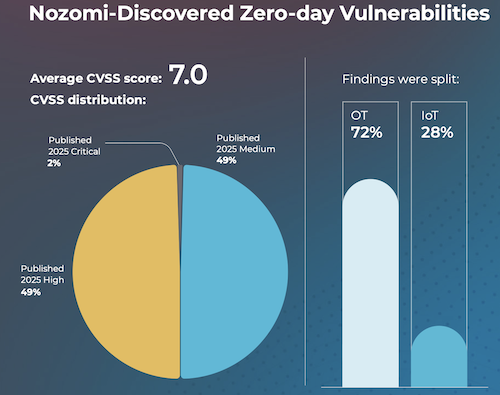
Source: Nozomi Networks
Additional findings from the report include:
- The transportation industry was the most targeted of all, followed by manufacturing and the public sector.
- Scattered Spider activity accounted for 42.9 percent of attacks observed in the second half followed by Kimsuky (out of North Korea), APT29 (out of Russia), CURIUM (out of Iran), and Mustard Tempest (no nation-state affiliation).
- Wireless networks continue to pose a severe security threat as 68 percent of observed wireless networks still operate without Management Frame Protection(MFP) despite using modern encryption.
Geopolitical tensions also reshaped the cyber threat landscape. Poland reported an attack against its critical infrastructure by the Russia-linked actor utilizing DynoWiper malware. Polish CERT attributed it to the Dragonfly group, while other research groups cited Sandworm.
In the second half last year, the top targeted countries were the U.S., the UK and Colombia, with the manufacturing and transportation the top sectors hit.
Collectively, the industry is an inflection point where attackers leveraged traditional techniques, such as data theft and ransomware extortion, and advanced techniques involving vulnerability exploitation and the use of AI.
This period reinforces the importance of proactive security governance with a focus on visibility, real-time threat detection, and comprehensive resilience planning.
Click here for more on the report.