
This past year, it appears attackers targeting operational technology (OT) crossed a line previously limited to a small number of well-known attacks impacting industrial control systems (ICS), according to Dragos 9th Annual Year in Review OT/ICS Cybersecurity Report.
Attackers are no longer gaining access and waiting. Rather, multiple threat groups, independently and across different geopolitical alignments, moved into actively mapping control loops: Identifying engineering workstations, exfiltrating configuration files and alarm data, and learning how physical processes operate well enough to disrupt them, the report said.
To that end, there are three new threat groups hitting the scene to keep an eye on.

AZURITE, PYROXENE, and SYLVANITE are the new threat groups and existing threat actors, VOLTZITE, KAMACITE, ELECTRUM, and BAUXITE are growing in their evolution of OT attackers.
Working Together
Several of these groups now operate in paired models where one team develops initial access and hands it off to a second team with ICS-specific capability, the researchers said. That division of labor compresses the timeline from compromise to operational readiness, in some cases from weeks to days, and lowers the barrier for the groups that ultimately cause impact.
ELECTRUM, the group responsible for the Ukrainian power outages in 2015 and 2016 and the most operationally experienced infrastructure-attack group Dragos is aware of, expanded its targeting beyond Ukraine into Poland in late December 2025.
That attack targeted decentralized energy resources (DER) in Poland, including combined heat and power facilities and renewable energy management systems. It was the first major coordinated cyberattack against DERs anywhere in the world.
Meanwhile, KAMACITE, the access development team that feeds ELECTRUM, expanded from Ukrainian targets into the European OT supply chain and conducted sustained reconnaissance of internet-exposed industrial devices across the United States between March and July 2025.
Additionally, adversaries also moved faster on vulnerabilities in 2025, the report found.
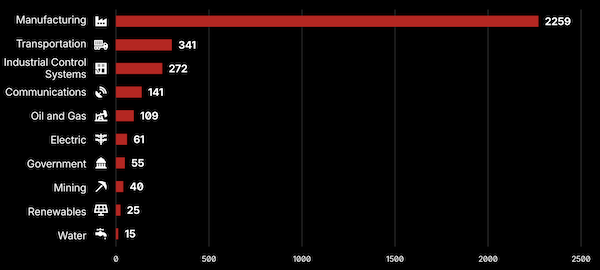
The following shows ransomware strikes by sector.
Source: Dragos
Median time from disclosure to public exploit was 24 days. Four percent of ICS vulnerabilities ended up actively exploited at disclosure. Moreover, in multiple incident response cases, Dragos reported exploited vulnerabilities to vendors and waited 90+ days for public advisories while attacks continued elsewhere. Meanwhile, 26 percent of advisories offered no patch, and 25 percent contained incorrect CVSS scores, leaving defenders with incomplete or wrong guidance while adversaries operationalized exploits.
Ransomware Continues Growth
On top of that, ransomware continued to hit industrial organizations hard.
Dragos tracked 119 ransomware groups impacting over 3,300 industrial organizations in 2025, compared to 1,693 attacks in 2024. But the numbers understate the problem. There is a persistent and significant mischaracterization of ransomware incidents as IT-only, driven by responders who see a Windows operating system and classify the incident without recognizing the system was hosting SCADA software or functioning as an engineering workstation.
In an interesting development, 30 percent of Dragos incident response cases in 2025 started not with a detected intrusion or a ransom note, but with someone saying: “Something seems wrong.”
In the majority of those cases, the data needed to answer whether cyber was an issue in the attack. The issue is no one collected the data. OT network telemetry is transient.
In short, if you are not recording it when it happens, the data is gone. You cannot investigate what you cannot see, and in a growing number of cases, asset owners are making public statements that incidents had nothing to do with cyber. That is not because the asset owners determined that to be the case, but because they lacked the data to determine anything at all.
Dragos estimates fewer than 10 percent of OT networks worldwide have network visibility and monitoring in place.
Fundamentals Work Best
The fundamentals of OT security – knowing what is in your environment, monitoring what is happening, controlling access, and getting prepared to respond – remain the most effective defense against every threat in this report.
As the threats get more aggressive and infrastructure gets more complex, the gap between what adversaries can do and what defenders can see is widening. The operational tempo of adversaries now outpaces the detection capabilities of most defenders. Closing that gap is not a technology problem. It is a prioritization and investment problem, and the window to address it is getting smaller.
Click here to register to download the report.