
For 2024, the cost for the industrial sector was $5.56 million compared to the previous year of $4.73 million, according to IBM’s annual Cost of a Data Breach Report. Energy also went up to $5.29 million from $4.78 million. Pharmaceuticals also jumped to $5.10 million from $4.82 million.
This industrial cost spike could reflect the need for organizations to prepare for a more rapid response, as organizations in this sector are highly sensitive to operational downtime. The time to identify and contain a data breach at industrial organizations was above the median industry, at 199 days to identify and 73 days to contain.
IBM’s annual Cost of a Data Breach Report – conducted independently by Ponemon Institute and sponsored, analyzed and published by IBM – studied 604 organizations impacted by data breaches between March 2023 and February 2024. Researchers looked at organizations across 17 industries, in 16 countries and regions, and breaches ranging from 2,100 to 113,000 compromised records. To gain on-the-ground insights, Ponemon researchers interviewed 3,556 security and C-suite business leaders with firsthand knowledge of the data breach incidents at their organizations.
Global Average Cost
Industrial, energy and pharma were just three of the industries polled where the global average cost of a data breach increased 10 percent over last year jumping up to $4.88 million, according to the report.

The reasons for the increase, IBM researchers said, include business disruption and post-breach customer support and remediation drove up the costs. When asked how they’re dealing with these costs, more than half of organizations said they are passing them on to customers. That could be an issue in a competitive market already facing pricing pressures from inflation.
On a happier note, researchers found applying security artificial intelligence (AI) and automation is paying off, lowering breach costs in some cases by an average of $2.2 million. AI and automation solutions are reducing the lifespan needed to identify and contain a breach and its resulting damage. Put another way, defenders without AI and automation to assist them can expect to take longer to detect and contain a breach, and see costs rise compared to those who use these solutions.
It is no secret cybersecurity teams remain consistently understaffed. IBM’s study found more than half of breached organizations faced severe security staffing shortages. This lack of trained security staff is growing as the threat landscape widens. The continuing race to adopt gen AI across nearly every function in the organization could bring with it risks and put even more pressure on these understaffed cybersecurity teams.
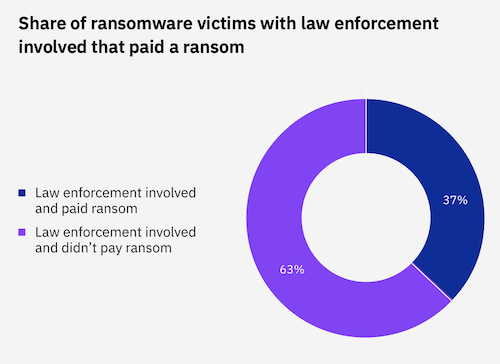
Data breach costs dropped dramatically when law enforcement investigators were a part of the picture as average costs ranged from $4.38 million with law enforcement involved to $5.37 million without law enforcement.
Source: IBM
In terms of risks, the amount an organization spends on extortion attacks can vary based on type – ransomware, data exfiltration and destructive – as well as the way the organization responds.
Law Enforcement Helps
This is particularly true if law enforcement ends up called in.
As this year’s study shows, costs dropped dramatically when law enforcement investigators were a part of the picture. Researchers looked at all three types of attacks, including ransomware, where data ends up encrypted and a ransom demanded; data exfiltration, where attackers steal data and the organization ends up extorted; and destructive, where attackers delete data and destroy systems for their own objectives.
Average breach costs ranged from $4.38 million with law enforcement involved to $5.37 million without law enforcement, a difference of more than 20 percent, or nearly $1 million.
Click here for more on the report.