
To that end, the cybersecurity landscape saw a range of significant developments that left an impact like the rise in sophisticated cyberattacks targeting large-scale entities and essential infrastructure, according to the Global Threat Landscape Report, a semiannual report by FortiGuard Labs.
Meanwhile, the need to understand where your attack surface gaps in detection, mitigation, and response lie is more vital than ever. The report said the threat landscape has been shifting and organizations need to build secure networking systems that can quickly adapt to changing business demands and the evolving threat landscape. Easier said than done.
The findings in this report represent the collective intelligence of FortiGuard Labs, drawn from a vast array of network sensors collecting threat events each day observed in live production environments around the world from more than 600,000 environments and 10 million sensors capturing detail about threats that hit our detection technology.

In looking at the industrial sector, over 40 percent of ransomware and wipers targeted the industrial sector in the second half of 2023, indicating cybercriminals remain focused on OT and the supply chain, the report said.
When it comes to ransomware, over 80 percent of leaders are “very” or “extremely” concerned about ransomware. Ransomware detections surged 13x higher over the first half of 2023, according to the report. That was followed by a 70 percent drop during the latter half of the year, during which we also saw fewer organizations detecting ransomware variants.
Many of these ups and downs can trace back to the dynamics of ransomware gangs. Some follow a high-volume, low-margin strategy, which results in a larger number of ransomware variants and victims, the report said. Other gangs set their sights on fewer organizations that can pay bigger ransoms using highly targeted attacks.
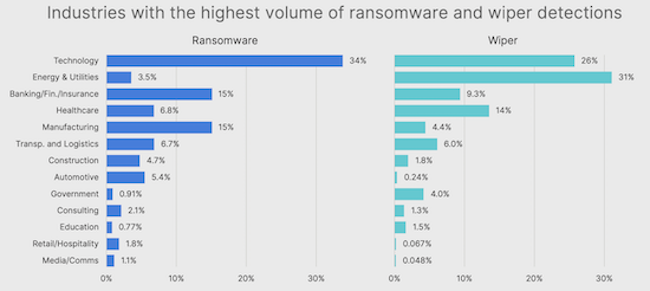
Industry breakdown of ransomware and wiper samples. In total, industrial sectors experienced 44 percent of all ransomware and wiper detections for the second half of 2023. This trend is concerning for many reasons, especially because of the impact critical manufacturing has on society in general.
Source: FortiGuard Labs
Looking at the FortiGuard 2024 threat predictions report, the forecast was adversaries would look for bigger payouts and would turn their attention to critical industries such as healthcare, utilities, manufacturing, and finance. In the second half of 2023, there was a shift away from the traditional “spray and pray” strategy, with cybercriminals taking a more targeted approach combined with ransom demands skyrocketing.
In terms of industries suffering from ransomware and wiper attacks picked up by the FortiGuard Labs’ sensors over the back half of 2023, the significant presence of industries such as energy, healthcare, manufacturing, transportation and logistics, and automotive offers some evidence of the targeted attack prediction.
Overall, industrial sectors experienced 44 percent of all ransomware and wiper detections for the second half of 2023.
Click here to download the report.