
And that is why an Aston University photonics expert is looking to make the production of wind power cheaper and safer.
To get to that level, Aston University associate professor Dr. Sergey Sergeyev received a grant of $127,397.50 (£100,000) from the Royal Academy of Engineering to find a cost-effective method of monitoring the condition of wind turbine blades.
Currently there isn’t a technique of revealing how existing damage to a blade started and progressed, which makes it difficult to work out how the damage ended up caused and its severity.

Sergeyev will be working with sensor technology company Insensys to develop a technique based on analyzing the fundamental property of light, and polarization. The approach combines fiber optics, laser physics, nonlinear science and signal processing disciplines.
Sergeyev works at Aston Institute of Photonic Technologies (AIPT) within the University’s College of Physical Sciences and Engineering, and has experience in polarization phenomena, fiber optic sensors, and laser physics.
His research will be cost-effective as it will involve exploring testbeds based on simple specimens of materials similar to actual blades.
“I’m delighted to have received this grant to explore methods for improving the efficiency of such an important source of green energy,” he said. “The condition monitoring of wind turbine blades includes damage detection, localization, classification and evaluation.
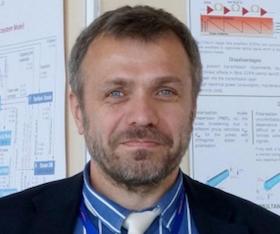
Dr. Sergey Sergeyev is looking to improve the efficiency of the condition monitoring of wind turbine blades, which includes damage detection, localization, classification and evaluation.
Source: Aston University
“My project is primarily based on fiber optic sensors – called fiber Bragg grating sensors – which have high sensitivity to distortions, such as stretch, twist and bend, which change the shape of the composite material.
“To explore such property we will advance our recently developed polarimetric technique to detect the structural defects.”
The Royal Academy of Engineering granted the award as an industrial fellowship and the research is expected to last two years.
AIPT is one of the largest photonics research centers in the UK, with a current portfolio of 65 research and industrial projects.