
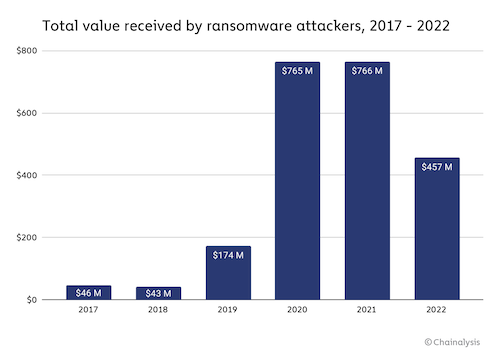
Those fears continued to rise this past year, but there was a glimmer of good news as ransomware attackers did extort at least $456.8 million from victims in 2022, but that was down from $765.6 million the year before, according to a report from Chainalysis.
While ransomware payments are down, it doesn’t mean attacks are down. Instead, researchers at Chainalysis said much of the decline is due to victims taking the advice of security professionals and law enforcement by refusing to pay ransomware attackers. Despite the drop in revenue, the number of unique ransomware strains in operation reportedly took off in 2022, with research from cybersecurity firm Fortinet stating over 10,000 unique strains were active in the first half of 2022.
Likewise, ransomware lifespans continue to drop. In 2022, the average ransomware strain remained active for just 70 days, down from 153 in 2021 and 265 in 2020, according to Chainalysis. This is likely related to ransomware attackers’ efforts to obfuscate their activity, as attackers are working with multiple strains.
The constant turnover amongst top ransomware strains and appearance of new ones would suggest the ransomware world is a crowded one, with a large number of criminal organizations competing with one another and new entrants constantly coming onto the scene, said Chainalysis researchers.

However, looks can be deceiving. While many strains are active throughout the year, the actual number of individuals who make up the ransomware ecosystem is likely quite small.
Most ransomware strains function on the ransomware-as-a-service (RaaS) model, in which the developers of a ransomware strain allow other cybercriminals, known as affiliates, to use the administrator’s malware to carry out attacks in exchange for a small, fixed cut of the proceeds.
However, Chainalysis researchers said they have seen time and time again that many affiliates carry out attacks for several different strains. So, while dozens of ransomware strains may technically have been active throughout 2022, many of the attacks attributed to those strains were likely carried out by the same affiliates.
Microsoft Security discussed an example of this earlier this year discussing one prolific affiliate group, whom they’ve labeled DEV-0237, who has carried out attacks using the Hive, Conti, Ryuk, and BlackCat ransomware strains.
Microsoft Security researchers were able to identify this example of affiliate overlap by analyzing the technical details of how the attacks were carried out, but we can also identify examples of affiliate overlap on the blockchain.
Based on the data available to us now, Chainalysis researchers said 2022’s total ransomware revenue fell to at least $456.8 million from $765.6 million in 2021 — a huge drop of 40.3 percent.
The evidence suggests this is due to victims’ increasing unwillingness to pay ransomware attackers rather than a decline in the actual number of attacks.
Click here for more information on the Chainalysis report.