
Organizations are under siege from a wide variety of threats, but ransomware offers threat actors a unique combination of very low risk with very high reward, which is why the volume of ransomware attacks nearly doubled from the previous year, and the total cost of ransomware exceeded $20 billion.
Ransomware began as little more than a new type of malware exploit with a different payload – generating revenue by extorting payment from victims – but it has evolved into a complex business model.
The malware is just one element of the much larger ransomware operation – or RansomOp – that make today’s attacks far more sophisticated.

To that end, ransomware continues to be a dominant concern.
Despite significant action by the Biden Administration, coordinated efforts by government and law enforcement agencies around the world, and an increased focus on ransomware, the volume of attacks nearly doubled in 2021.
Of the 1400+ cybersecurity professionals who participated in a second Cybereason study, 73 percent said their organization was targeted by at least one ransomware attack in the preceding 24 months, compared to just 55 percent of companies who had been targeted by at least one attack in the 2021 report, an increase of 33% year over year, according to the “2022 Ransomware: The True Cost to Business report by Cybereason.”
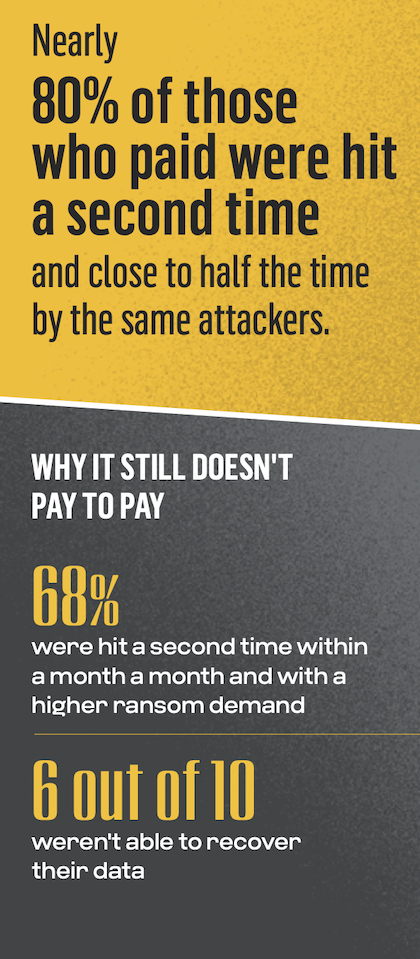
Any time there is a ransomware attack, law enforcement and security professionals advise against paying the ransom. To that end, 80 percent of those who paid were hit a second time and close to half the time by the same attackers. In addition, 68 of respondents who paid once said they were hit again in less than a month for a higher ransom.
Source: Cybereason
Ransomware attacks can negatively impact an organization in many ways, with combined losses potentially reaching tens or even hundreds of millions of dollars. Last year’s study revealed the vast majority of organizations that had suffered a ransomware attack also experienced a significant business impact, whether revenue loss, reputational damage, unplanned workforce reductions, or in some cases business disruption.
Short-term impacts revealed in the report included disruption of critical business processes due to the inability to access critical systems and data, costs associated with incident response and other mitigation efforts, lost productivity, and the cost of the ransom payment itself if the organization chose to acquiesce to the extortion demand.
Longer-term impacts included diminished revenue, damage to the organization’s brand and reputation, the loss of key executives, employee layoffs, loss of customers and strategic partners, and the viability of the business altogether in some instances.
Of the organizations that paid one or more ransom demands following successful attacks, 49 percent said their primary motivation for paying was to avoid any loss of revenue, while 41 percent cited the need to expedite recovery as the main driver for payment, both of which seemingly make sense from a business viability and continuity standpoint.
Some companies decided to pay the ransom because they weren’t prepared for a ransomware attack. For example, 27 percent said they paid the ransom because they hadn’t backed up their data. One-third (34 percent) indicated they were simply too short-staffed to attempt an effective response without the assistance of the attackers, both of which are preventable conditions for organizations that take the threat of ransomware seriously and are indicators that these organizations simply aren’t prepared.
Click here for more on the report.