
There’s a clear gap between what safety leaders want and what they currently have. Nearly three in four organizations are still straddling the paper-digital divide, managing safety through a patchwork of manual processes, spreadsheets, and disconnected tools. Meanwhile, the data shows that simplicity drives adoption that safety programs need to succeed, according to a report released by Novara entitled, “The Simplicity Imperative.”
The industry learned a hard lesson the expensive way: Complexity is the enemy of adoption. Organizations bought platforms that didn’t work – not because the software was broken, but because workers wouldn’t use it.
Ease of Use
Today, 55 percent of safety leaders rank ease of use and user adoption as the most important factor when evaluating safety management platforms. Not cost. Not features. Not integration capabilities.

This represents a fundamental shift in how buyers think about safety technology.
For years, organizations purchased feature-rich platforms that checked every procurement box, and then watched adoption collapse in the field. Workers avoided systems that took too long to learn, required multiple screens to complete simple tasks, or simply didn’t work reliably on a job site.
What ease of use actually means varies by role.
- For safety directors, it means fewer steps, clearer workflows, and automated reminders that eliminate manual follow-up.
- For operations leaders, it means faster work, standardized processes, and tools that don’t slow down crews.
- For executives, it means lower cost of ownership, faster rollout, and return on investment that actually materializes.
The contrast is stark and the math is simple: Crews avoid complex systems or revert to paper. A platform that workers avoid is a platform that doesn’t work. Mobile-first workflows designed for the field get used, and tools that get used actually deliver results.
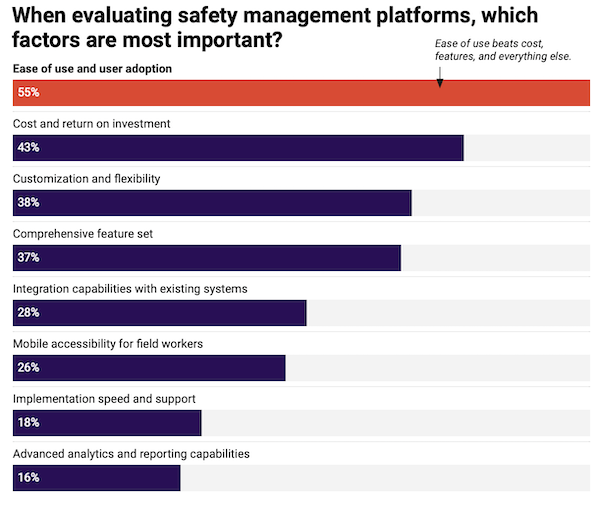
Ease of use is the top factor when it comes to evaluating safety management platformsSource: Novara
The following are six challenges that have the biggest impact on program effectiveness:
Frontline engagement:
More than one in three safety leaders identified frontline engagement and employee buy-in as the single biggest challenge impacting their safety program effectiveness. This finding has profound implications for how organizations should evaluate safety technology. You can build the perfect safety program on paper. You can purchase the most feature-rich software platform. But if frontline workers don’t use it, none of it matters. For Safety Directors, this challenge manifests as the daily frustration of chasing overdue tasks, fixing incomplete data, and watching carefully designed processes get ignored in the field. For Operations leaders, disengaged workers mean inconsistent execution across sites and shifts. For executives, engagement gaps translate directly into compliance exposure and liability risk.
Communication and reporting gaps:
Nearly a quarter of respondents (22 percent) cited delayed incident reporting and communication gaps as their biggest challenge. When information doesn’t flow from field to office in real-time, safety teams are perpetually playing catch-up. This challenge is particularly acute in industries with distributed workforces: Construction crews spread across multiple job sites, manufacturing operations running multiple shifts, field service teams working in remote locations. Without real-time communication tools workers actually use, safety managers lack the visibility they need to respond to issues before they escalate.
Compliance complexity:
Compliance tracking and regulatory reporting complexity affects 12 percent of respondents as their primary challenge. For safety directors, this often means audit anxiety and the constant fear of missing a changing requirement. For CFOs, compliance failures represent financial risk in the form of fines and penalties. For COOs, compliance gaps can trigger operational disruptions that ripple through the entire organization.
Administrative burden:
Time-consuming manual data entry and report compilation drains 11 percent of safety teams as their primary challenge. This represents hours spent on paperwork instead of prevention—hours that could end up spent identifying hazards, coaching workers, and building a proactive safety culture. When safety managers spend more time documenting safety than improving safety, the entire organization suffers.
Data and analytics gaps:
The difficulty of identifying trends and analyzing safety data affects another 11 percent of respondents. Without clear visibility into patterns and leading indicators, safety teams can’t shift from reactive incident response to proactive hazard prevention.
ROI visibility:
The inability to demonstrate ROI and value of safety programs to leadership rounds out the top challenges at 10 percent. This creates a problematic cycle: Safety directors need resources to improve programs, but struggle to justify investments to executives who want to see clear returns.
Click here to register for the report.