
By using hydrated salts, researchers engineered this material to regulate battery temperatures, paving the way for safer and more efficient battery applications. The research emphasizes the dual benefits of improved energy densities and longevity while addressing pressing safety concerns associated with high-rate charging and discharging.
Lithium-ion batteries (LIBs) have become indispensable in electric vehicles and energy storage, offering high energy density and operational stability. However, these batteries are highly temperature-sensitive and prone to thermal runaway, especially under conditions of rapid charging.
In a study from North China Electric Power University, researchers introduced a CPCM composed of Na2SO4-10H2O and expanded graphite (EG).

This advanced hydrated salt material boosts thermal conductivity, enabling efficient heat absorption and release. With an optimal melting point of 29°C, the CPCM employs a two-stage temperature control mechanism to prevent overheating, effectively reducing peak LIB temperatures from 66 °C to 34°C during typical use. Additionally, this passive system delays the onset of TR events, providing essential time for cooling measures.
The CPCM’s two-stage temperature control effectively manages LIB heat, absorbing energy through high-latent-heat phase transitions while retaining stability via enhanced thermal conductivity.
Key properties – such as an ideal melting point, high latent heat (183.7 J·g−1), and robust thermal conductivity (3.926 W·m−1·K−1) – support consistent temperature reduction. Under normal conditions, it absorbs peak heat generated by high-rate discharges, maintaining LIB temperatures within safe limits.
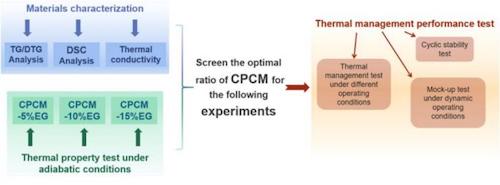
Research roadmap showing composite phase change material for lithium-ion battery thermal management.
Source: Jingshu Zhang
During TR scenarios, the material’s dehydration phase prolongs the time to critical temperatures by up to 187 seconds. Additionally, the CPCM design resolves phase separation issues that have hindered traditional thermal management materials. Tests under cyclic and dynamic conditions confirm CPCM-10 percent EG provides long-term stability, efficiently managing temperature fluctuations in high-stress applications.
“Effective temperature control is vital for preventing failures in high-demand applications like electric vehicles,” said Dr. Xing Ju, lead researcher of this study. “This CPCM offers a unique, energy-efficient solution that reduces dependency on complex active systems and bolsters battery safety. Its dual-stage control demonstrates strong potential as a passive thermal safeguard, especially in cases where active management might be unreliable or too costly.”
This breakthrough in CPCM technology holds promising applications across industries reliant on LIBs.
In electric vehicles, it could add a crucial layer of thermal stability, reducing risks of battery fires or explosions under extreme conditions. Beyond automotive use, CPCMs show potential for energy storage systems, where consistent temperature control is vital.
As LIBs continue expanding in personal and industrial sectors, this CPCM provides a scalable, efficient approach to supporting the safe, long-term use of high-energy-density batteries.
Click here to view the entire paper.