
Those hairs inspired a University of Texas at Dallas researcher to develop a sensor to monitor turbulence in the deep ocean.
“The geometry of seal whiskers is not circular; the whisker’s shape is twisted cylinders,” said Dr. Yaqing Jin, assistant professor of mechanical engineering in the Erik Jonsson School of Engineering and Computer Science. As a result of his study, Jin earned an Early-Career Fellow of the Gulf Research Program of the National Academies of Sciences, Engineering, and Medicine for his research on offshore wind turbine safety.
Sense Changes in Ocean
“Those twisted cylinder shapes allow seals to sense changes in the ocean environment. The same shapes can help us design sensors in the lab to detect changes in water flow that could warn offshore wind turbine operators about dangerous conditions,” he said.

Moreover, in his Fluids, Turbulence Control & Renewable Energy Lab, Jin and his research team test whisker-inspired designs in a 6-foot-long clear rectangular water channel. A pump moves water into the tube at different velocities to simulate the ocean environment.
Furthermore, sensors sensitive to vibration have advantages over the traditional underwater sensing technology using sound waves, which can disturb marine life, Jin said.
Technology to monitor harsh conditions in the deep ocean is critical for the expansion of offshore wind energy. Additionally, most wind energy ends up generated currently by turbines on land. Furthermore, offshore wind is the next opportunity for growth. Harsh storms in the deep ocean, however, can be dangerous for offshore turbines, which attach to the ocean floor with cables and have “floating” platforms not fixed to the sea floor.
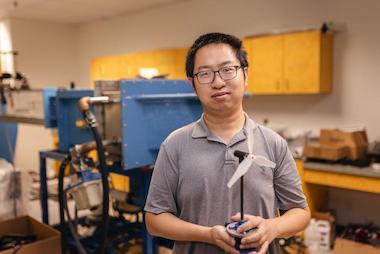
Dr. Yaqing Jin, assistant professor of mechanical engineering at The University of Texas at Dallas, studied seal whiskers to develop a sensor to detect vibrations that could then ensure the safety for offshore wind turbines.
Source: University of Texas at Dallas
A sensor that provides warnings about hazardous conditions in the deep sea could save lives by giving technicians time to reach safety, Jin said. The engineer also is developing sensors to protect the parts of offshore turbines above water, including the tower and blades, from wind damage.
Blowing Sand
Jin’s lab includes a sand blowing system with adjustable particle volume fractions and sand ejection speed. The setup allows researchers to study how sand blowing in the air affects turbine or rotorcraft blades. Earlier this year, Jin received a $360,000 Early Career Program Award from the U.S. Army Combat Capabilities Development Command Army Research Laboratory for a project to test the impact of sand on rotating blades.
“With wind turbines, you don’t want the blades to bend,” he said. “If winds are too strong, the tower could break down. The risks for offshore turbines are even greater.”
Since Jin joined UT Dallas in 2019 to be a part of the University’s growing wind research programs through the Wind Energy Center. Since then, he said he has seen an increase in students who want to prepare for careers in the wind energy industry.
“Clean energy has become one of the big topics around the world,” Jin said. “One of the biggest potential sources of clean energy comes from wind energy. In the future, there will be more focus on offshore wind production because it can generate more energy than turbines on land.”