
In addition to having a safety moment before a meeting, why not have a security moment as well, security professionals would say.
Today, the security culture is very similar to the safety mentality which is best understood as the collective mindset, practices and norms that shape how an organization approaches and prioritizes security.
Under this concept, organizations need to direct their energy toward boosting employee involvement through evaluations and training, refining processes and protocols and adopting technologies that simplify adherence to security best practices.

To that end, KnowBe4 Research released its yearly Security Culture Report. The report systematically evaluates culture across seven distinct dimensions: Attitudes, behaviors, cognition, communication, compliance, norms and responsibilities.
Add on top of that researchers created the Security Culture Maturity Model, an industry tool designed specifically to assess security culture.
There are five levels in the maturity model:
- Basic compliance, where there is a bare minimum of training Limited metrics, with a “Check the box” mentality.
- Security awareness foundation, where there is at least annual and onboarding training and occasional phishing simulations and a focus on variety of content.
- Programmatic security awareness and behavior, where there is an intentional awareness program with integrated tools and quarterly training with simulated phishing. There is also a focus on security-aware behaviors.
- Security behavior management, where there is continuous training across varied delivery methods and audiences, a heavy use of integrated tools to inform training strategy, and a program focused on real behavior change.
- Sustainable security culture, where there is a program that intentionally measures, shapes and reinforces security culture and multiple methods of behavior-based encouragement. At this level security values end up woven through fabric of entire organization.
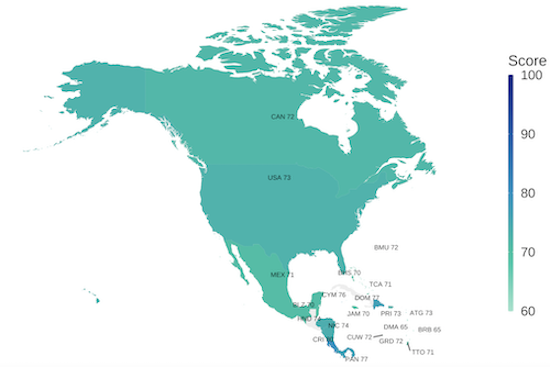
Security culture score in North America.
Source: KnowBe4
In 2023, researchers collected insights on 816,733 employees representing 4,078 organizations. The overall security culture score globally stands at 72 (low moderate), unchanged from the prior year. As one would expect, smaller organizations tend to have higher culture scores. It’s far easier to change the culture of a smaller group than a larger one.
The importance of security culture is gaining momentum in North American organizations, especially among leaders. The North American Manufacturing sector has sustained a decades-long emphasis on security culture, and organizations across industries have observed the fruits of this labor: Safer working environments and fewer accidents. North American leaders understand how a strong culture can have similar positive impacts on cybersecurity. Organizations that have successfully built a strong safety culture are applying the same strategy and tactics to improve their security culture.
The United States had a culture score of 73, while Canada was 72 and Mexico was 71
Click here for more on the security culture report.