
Watching videos of a soft robot working with a person at picking and placing tasks lowered the viewers’ safety concerns and feelings of job insecurity, according to a Washington State University (WSU) study.
This was true even when the soft robot was working in close proximity to the person. This finding shows soft robots hold a potential psychological advantage over rigid robots made of metal or other hard materials.
“Prior research has generally found that the closer you are to a rigid robot, the more negative your reactions are, but we didn’t find those outcomes in this study of soft robots,” said lead author Tahira Probst, a WSU psychology professor.
Currently, human and rigid robotic workers have to maintain a set distance for safety reasons, but as this study indicates, proximity to soft robots could be not only physically safer but also more psychologically accepted.

“This finding needs replication, but if it holds up, that means humans could work together more closely with the soft robots,” Probst said.
The study did find that faster interactions with a soft robot tended to cause more negative responses, but when study participants had previous experience with robots, faster speed did not bother them. In fact, they preferred the faster interactions. This reinforces the finding that greater familiarity increased overall comfort with soft robots.
About half of all occupations are highly likely to involve some type of automation within the next couple decades, particularly those related to production, transportation, extraction and agriculture, Probst said.
Soft robots, which consist of flexible materials like fabric and rubber, are still relatively new technology compared to rigid robots which are already widely in use in manufacturing.
Rigid robots have many limitations including their high cost and high safety concerns – two problems soft robots can potentially solve, said study co-author Ming Luo, an assistant professor in WSU’s School of Mechanical and Materials Engineering.
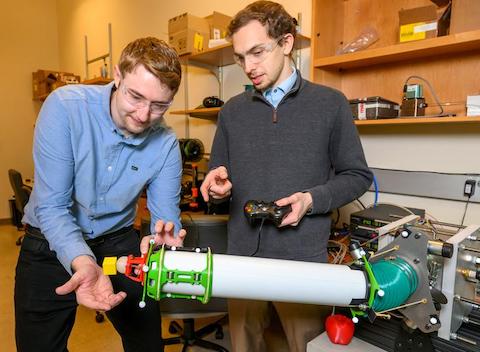
Washington State University doctoral students Justin Allen, left, and Ryan Dorosh, demonstrate a soft robot in development.Source: Dean Hare, Washington State University Photo Services
“We make soft robots that are naturally safe, so we don’t have to focus a lot on expensive hardware and sensors to guarantee safety like what has to be done with rigid robots,” Luo said.
As an example, Luo noted one rigid robot used for apple picking could cost around $30,000 whereas the current research and development cost for one soft robot, encompassing all components and manufacturing, is under $5,000. Also, that cost could substantially decrease if production scaled up.
Luo’s team is in the process of developing soft robots for a range of functions, including fruit picking, pruning and pollinating. Soft robots also have the potential help elderly or disabled people in home or health care settings. Much more development has to occur before this can be a reality, Luo said, but his engineering lab partnered with Probst’s psychology team to better understand human-robot interactions early in the process.
“It’s good to know how humans will react to the soft robots in advance and then incorporate that information into the design,” Probst said. “That’s why we’re working in tandem, where the psychology side is informing the technical development of these robots in their infancy.”