
While third-party attacks are continuing to grow, so, too, is the impact while the speed of disclosure can be very slow. In the end, the supply chain does not break at its weakest link, rather, it breaks at its most connected one. To manage risk in 2026, security experts should address the structural fragility of the core, according to a Black Kite Research Group report entitled, “Supply Chain Cyber Attacks in 2025, Why Cascading Impact Outpaced Disclosure.”
The number of verified third-party attack incidents reached 136 major events last year, according to the report. While 719 companies were publicly named as victims, a much larger “shadow layer” emerged behind aggregate disclosures.
This visibility gap widened by a persistent “Silent Window:” While the median time to detect an intrusion was 10 days, the median delay to disclose that breach to the public was 73 days.

Transfer of Risk
In an environment where threat actors (who remained unknown or undisclosed in nearly 73 percent of cases) move with “industrialized” speed, this delay represents a massive transfer of risk from the vendor to the unsuspecting customer.
Across a baseline of 200,000 monitored organizations, the ecosystem appears healthy on paper with an average Cyber Grade of 90.27 (A). However, this high grade creates a false sense of security that masks deep operational rot.
To that end, nearly 54 percent of organizations show patch-management failure signals, and over 23 percent have active stealer log exposure. This creates “Pressure Zones,” particularly in manufacturing and professional services, where high susceptibility and weak discipline overlap. In these zones, breaches don’t emerge in a vacuum; they expand because the basic controls required to stop them are inconsistent.
This Black Kite report shows an analysis of third-party data breaches observed in 2025. It explores how these incidents occurred, their impact on organizations, and examines the structural conditions that continue to shape third-party cyber risk at scale.
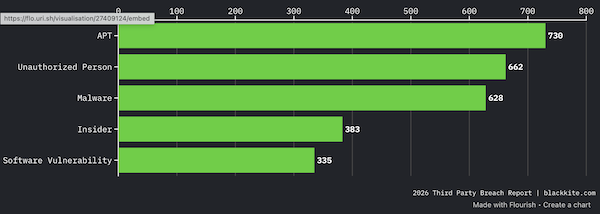
Chart shows the days between initial compromise and detection.
Source: Black Kite
In 2025, third-party risk stopped knocking and started breaking down doors. The number of verified, publicly disclosed third-party breach events reached 136, breaking the steady pattern of previous years.
But counting events is no longer enough. The blast radius has fundamentally changed. Across these incidents, Black Kite identified 719 named victim companies, representing only the portion of impact likely disclosed.
Downstream Impact
In 27 separate incidents, vendors disclosed downstream impact only in aggregate terms, revealing approximately 26,000 additional companies ended up affected, but never named, according to the report. At the individual level, publicly disclosed figures point to 433 million impacted people, a population roughly equivalent to the entire European Union.
This shift also explains why 2025 reached an average of 5.28 downstream victims per third-party breach, the highest level observed to date. Compare that to 2.46 victims per incident in 2021, 4.73 in 2022, 3.09 in 2023, and 2.56 in 2024.
This reflects a sharp increase in the scale and coordination of attacks, driven by more aggressive threat actors targeting shared platforms, centralized services, and high-dependency vendors. As attackers move upstream, single compromises increasingly translate into multi-company impact.
This past year was not just a year of more breaches; it was the year where the scale of impact outpaced our ability to name the victims.
On the vendor side, breach events most frequently end up associated with a small number of highly central service categories. Software services lead by a wide margin, followed by technical services and healthcare services. These vendors are not numerous, but they operate as shared infrastructure for thousands of organizations. Their position in the ecosystem means a single failure can propagate broadly.
On the company side, impact concentrates in sectors that consume these shared services at scale. Healthcare, educational services, and finance appear most frequently among affected organizations. These sectors tend to combine high data sensitivity with heavy reliance on external platforms, placing them downstream in complex dependency chains.
Visibility Breaks Down
Third-party risk does not scale only because of technical failure. It scales because visibility breaks down where dependency is highest.
For the 79 breach events where timeline data was available, the median time to detect an intrusion was 10 days. When it comes to cybersecurity, 10 days is not “fast.” It is more than enough time for an attacker to fully operationalize an intrusion.
In 10 days, a threat actor doesn’t just steal data; they map the network, escalate privileges, plant backdoors, and exfiltrate entire databases.
For the typical vendor, it means the attackers had full run of the house for over a week before anyone realized the door was open.
While the median sits at 10 days, the average detection time spiked to 68 days, driven by a long tail of sophisticated attacks that went unnoticed for months or even years.
This proves that while automated attacks like ransomware might trigger alarms quickly, the quiet, sophisticated attacks the ones that do the most strategic damage are still operating with near impunity.
The 10 day median detection timeline observed in our dataset is consistent with broader industry reporting. For context, Mandiant’s M-Trends 2024 report similarly identified the global median dwell time as 10 days. This parallel suggests the “Silent Window” observed in this report reflects a wider operational standard across the current threat landscape, rather than being an anomaly specific to our dataset.
Click here for more on the report.