
The January 23, 2023, ruptured reboiler not only released the gases and fluids, but Honeywell estimated $4 million of property damage resulted from the incident.
The good news is there were no injuries as a result of the release, but the company endured a complex-wide shelter-in-place for a while.
Started Up in 1967
In terms of background, the facility started up in 1967 by the Allied Chemical and Dye Corporation. In 1985, Allied merged with Signal Companies and became AlliedSignal, and in 1999, AlliedSignal acquired Honeywell and retained the Honeywell name. The unit involved in the incident began operating in 2003 and manufactures 1,1,1,3,3-Pentafluoropropane, also known as “HFC- 245fa.”

Additionally, as of January 2023, the operation of the Honeywell site involved 300 employees and 300 contractors. At the time of the incident, 40 Honeywell employees and 46 contractors were present on site during the night shift.
During the incident, after the release caused by the reboiler rupture, a vapor cloud engulfed part of the Honeywell site. Furthermore, the cloud contained anhydrous HF, chlorine, HFC-245fa, and various process intermediates.
HF is a colorless vapor at atmospheric conditions. When dissolved in water, it is hydrofluoric acid. HF is highly toxic, and skin contact with liquid HF or HF acid can result in severe burns, deep tissue and bone damage, and death. Furthermore, if inhaled, HF vapor can cause severe lung injury and death. In the chemical industry, HF produces refrigerants and as an alkylation catalyst in the production of high-octane gasoline at petroleum refineries, among other uses.
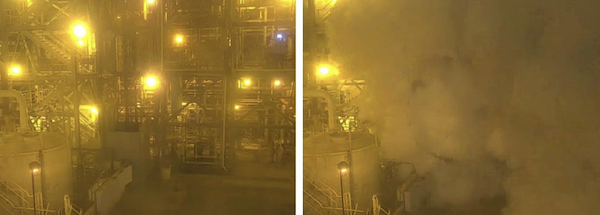
Surveillance images immediately before (left) and four seconds after (right) the reboiler rupture.
Source: Honeywell
The Honeywell HFC-245fa unit contains a distillation column that includes a kettle-style reboiler. A reboiler is a type of heat exchanger used to vaporize and return to the column some or all of the liquid bottoms product within a distillation column.
Reboiler Shell
The reboiler shell normally contained a mixture of HF, HFC-245fa, and smaller fractions of various process intermediates. The exchanger tubes normally contained steam as the heating medium.
Additionally, at the time of the incident, the reboiler tube bundle consisted of Alloy 825 and the shell comprised SA-516 Grade 70 carbon steel.
At 7:03 p.m. on the day of the incident, Honeywell began restarting the HFC-245fa unit after the site experienced a utility outage. Operations established feed to the distillation column at 7:16 p.m. At 8:12 p.m., the reboiler shell catastrophically ruptured.
The process conditions in the reboiler shell at the time of the incident were within the normal as-designed safe operating limits of the reboiler. The temperature and pressure in the reboiler shell at the time of the incident were greater than the fluids’ atmospheric boiling points.
Based upon the temperature and pressure in the reboiler at the time of the failure, a boiling liquid expanding vapor explosion (BLEVE) occurred. The contents of the reboiler, the distillation column, and other ancillary equipment released into the air.
In total, the incident resulted in the release of 871 pounds of HF, 1,684 pounds of chlorine, 1,754 pounds of HFC-245fa, and 220 pounds of various process intermediates. The release continued from 8:12 p.m. until 9:00 p.m. An “all-clear” signal was given for the industrial complex at 9:15 p.m.

Post-incident image showing the remnants of the reboiler.
Source: Honeywell
Thinned Reboiler Shell
After the incident, Honeywell contracted metallurgical testing and examination of the failed reboiler shell. The examination found the reboiler shell had severely thinned due to HF corrosion of the carbon steel. Moreover, Honeywell found at least two locations on the shell to be as thin as 0.03 inches, corresponding to a thickness loss of roughly 95 percent.
The reboiler shell ruptured into at least nine fragments, which were propelled up to 35 feet away. The largest fragment contained the tube side head, the complete tube bundle, and the eccentric conical section of the shell, which they found 35 feet from the reboiler’s original location.
Continuing the investigation, the CSB is gathering facts and analyzing several key areas, including:
- Honeywell’s mechanical integrity policies and practices
- Honeywell’s project management policies and practices
- Relevant facility, corporate, and industry standards
Click here for more on the CSB update.