
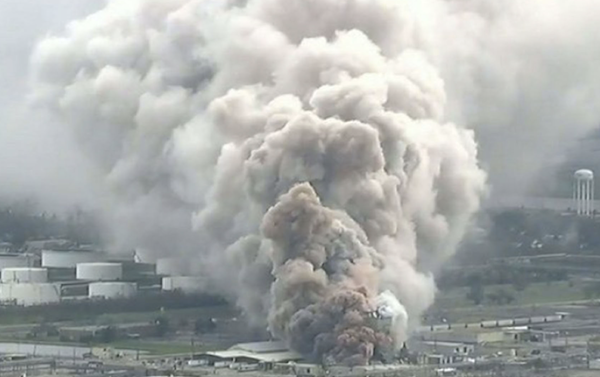
Contributing to the incident were Bio-Lab’s inadequate preparation for extreme weather and Bio-Lab’s deficient process hazard analysis action item management system, said officials at the Chemical Safety and Hazard Investigation Board (CSB) in their final report on the incident. Also contributing was insufficient regulatory coverage of chemicals with reactive hazards. Contributing to the severity of the incident were Bio-Lab’s inadequate and largely nonfunctional fire protection system and the absence of automatic extinguishing systems.
TCCA is a chlorinating agent often used as a sanitizer to kill algae and bacteria in large volumes of water, predominantly swimming pools and hot tubs, and sold in tablet, stick, and granular forms. In large bodies of water, TCCA is soluble and breaks down slowly, releasing chlorine in the water to sanitize contaminants.
When TCCA instead comes in contact with or is wetted/moistened by a small amount of water and does not dissolve, it can experience a chemical reaction, generating heat and causing the decomposition of the chemical, which in turn produces toxic chlorine gas and can produce explosive nitrogen trichloride.

After the buildings at the Bio-Lab facility suffered damage from Hurricane Laura winds, rainwater came in contact with the TCCA stored inside, initiating a chemical reaction and subsequent decomposition of the TCCA. The heat produced from the reaction and decomposition initiated a fire, and the decomposition released a large plume of hazardous gases, including toxic chlorine, into the air. The plume of hazardous gases crossed the facility boundary and could be seen over a large portion of the nearby community.
The TCCA decomposition and fire destroyed a production building at the Bio-Lab facility and damaged additional structures.
In addition, as a result of the incident, a portion of the nearby Interstate 10 was closed for over 28 hours, and the Calcasieu Parish Office of Homeland Security and Emergency Preparedness issued a shelter-in-place order due to the release of the hazardous gases. Following the incident, the company spent $250 million to redesign and completely reconstruct the damaged Bio-Lab facility. The Bio-Lab facility resumed its production operations in March this year. There were no reported injuries from this chemical disaster.
The CSB’s investigation identified the safety issues:
Extreme Weather Preparation. Bio-Lab did not learn about the importance of preparing for extreme weather after the 2017 Arkema incident in Crosby, Texas, which occurred after extensive flooding from Category 4 Hurricane Harvey caused an organic peroxide decomposition that led officials to institute a 1.5-mile evacuation zone during the incident. Bio-Lab did not implement industry guidance for extreme weather preparation updated and published after the Arkema incident and, as a result, remained unprepared for the winds produced by Category 4 Hurricane Laura.

Decomposing TCCA in Plant 4 on August 27, 2020.
Source: Louisiana State Police, with annotations by CSB
Process Hazard Analyses Implementation. TCCA is not covered by the Occupational Safety and Health Administration (OSHA) Process Safety Management (PSM) Standard; however, Bio-Lab Lake Charles voluntarily implemented some elements of the PSM standard, including periodically conducting Process Hazard Analyses (PHAs). Bio-Lab’s 2010 Process Hazard Analysis recommended the Lake Charles facility to “consider evaluating warehouse roof structure for hurricane conditions; verify warehouse is built to withstand high winds,” but the company did not implement the recommendation. If Bio-Lab had implemented the 2010 PHA recommendation, it could have identified the facility buildings were susceptible to damage from hurricane-strength winds. This might have led Bio-Lab to implement controls to prevent the TCCA from exposure to hurricane rainwater, which could have prevented the incident. A lack of close-out documentation for the 2010 PHA recommendation indicates deficiencies in Bio-Lab’s PHA action item management system.
Emergency Preparedness and Response. Bio-Lab experienced serious delays in responding to the TCCA decomposition and fire due to an inadequate and largely nonfunctional fire protection system and the absence of automated sprinkler systems. The approximately five-and-a-half hour delay in responding to the decomposition likely led to an unnecessary increase in the amount of TCCA that decomposed, the quantity of toxic chlorine released, and the extent of the facility damage. Bio- Lab did not adequately maintain its fire protection system to ensure its functionality and did not ensure that enough of its staff, including its assigned hurricane crew, knew how to activate the rental backup generator, which was necessary to operate electrically powered fire protection equipment during the power outage caused by Hurricane Laura.
Adherence to Applicable Hazardous Materials Codes. The Bio-Lab Lake Charles facility, built in 1979, did not conform to the safeguards identified in the National Fire Protection Association (NFPA) 101 Life Safety Code for high-hazard industrial occupancies, which required automatic extinguishing systems or other protection to minimize danger to occupants before they have time to evacuate. Bio-Lab also did not conform to NFPA 400 Hazardous Materials Code, which required a fire detection system and an automatic fire sprinkler system, and which Louisiana requires adherence to for structures built or remodeled after July 1, 2017. Existing facilities in Louisiana, such as Bio-Lab, are grandfathered to the state-adopted codes and standards at the time of construction unless changes are made or if the State Fire Marshal receives a complaint. Had the Bio-Lab buildings involved in the incident been equipped with automatic extinguishing systems, it is likely that Bio-Lab would have begun applying large amounts of water to the decomposing TCCA earlier in the incident.
Regulatory Coverage of Reactive Chemical Hazards. Although TCCA can decompose and release toxic chlorine gas, TCCA is not regulated under the OSHA PSM Standard or the U.S. Environmental Protection Agency (EPA) Risk Management Program (RMP) Rule. As such, Bio-Lab was not required to implement baseline process safety management system elements to manage the safety of its TCCA- related operations under these regulations. OSHA and the EPA currently use predefined chemical lists to identify the processes subject to coverage under the PSM Standard and RMP Rule. The CSB’s Reactive Hazard Study, published in 2002, concluded that solely using lists of chemicals is an inadequate approach for regulatory coverage of reactive hazards. Improving reactive hazard management requires regulators and industry to address the hazards from combinations of chemicals and process-specific conditions rather than focus exclusively on the inherent properties of individual chemicals. The CSB also found OSHA and EPA did not adequately consider reactive chemical hazards when developing these chemical lists, and, as a result, many reactive chemicals, including TCCA, are not covered by these regulations. This regulatory coverage gap relating to reactive chemicals and their hazards points to a weakness in relying on fixed chemical lists to determine regulatory coverage, contributed to this incident, and contributed to many other reactive chemical incidents over the past three decades.
To prevent future chemical incidents, and in the interest of driving chemical safety change to protect communities, workers, and the environment, the CSB made the following safety recommendations:
Occupational Safety and Health Administration (OSHA): Amend the Process Safety Management Standard (PSM), 29 CFR 1910.119, to achieve more comprehensive control of reactive hazards that could have catastrophic consequences.
To the Environmental Protection Agency (EPA): Revise the Accidental Release Prevention Requirements, 40 CFR 68, to explicitly cover catastrophic reactive hazards that have the potential to seriously impact the public, including those resulting from self-reactive chemicals and combinations of chemicals and process-specific conditions. Take into account the recommendations of this report to OSHA on reactive hazard coverage. Seek congressional authority if necessary to amend the regulation.
Implement the five open recommendations issued in the 2022 U.S. Government Accountability Office Report titled Chemical Accident Prevention: EPA Should Ensure Regulated Facilities Consider Risks from Climate Change, which are:
- The EPA should provide additional compliance assistance to Risk Management Program (RMP) facilities related to risks from natural hazards and climate change
- The EPA should design an information system to track common deficiencies found during inspections, including any related to natural hazards and climate change, and use this information to target compliance assistance
- The EPA should issue regulations, guidance, or both, as appropriate, to clarify requirements and provide direction for RMP facilities on how to incorporate risks from natural hazards and climate change into their risk management programs
- The EPA should develop a method for inspectors to assess the sufficiency of RMP facilities’ incorporation of risks from natural hazards and climate change into risk management programs and provide related guidance and training to inspectors
- The EPA should incorporate the vulnerability of RMP facilities to natural hazards and climate change as criteria when selecting facilities for inspection
To Bio-Lab Lake Charles: Evaluate the hazards to the Bio-Lab Lake Charles facility from hurricanes and accompanying wind, rainwater, floodwater, or storm surge forces. Implement processes and safeguards for protection against those hazards.
Develop and implement an improved Process Hazard Analysis (PHA) action item management system.
Periodic audits must end up conducted on the PHA action item management system to ensure its effectiveness.
Perform process hazard analyses (PHAs) on all buildings and units processing or storing trichloroisocyanuric acid. Ensure the PHAs are revalidated at least every five years. Also include the building design basis as process safety information for the PHA team to reference during their analysis.
Revise the Bio-Lab Lake Charles emergency response plan.
To the Louisiana Governor, State Legislature and the Department of Environmental Quality: Under existing statutory or regulatory authority or through the establishment of new authority by executive or legislative action, for all existing chemical manufacturing and storage facilities located in a hurricane-prone region as defined by the International Building Code and manufacture or store or can inadvertently or otherwise produce regulated substances inside equipment or building(s) built before more current wind design requirements came into effect: Require the facility operators to evaluate the hazards to their facilities from hurricanes and accompanying wind, rainwater, floodwater, or storm surge forces. Require the facility operators to implement processes and safeguards for protection against those hazards, such as through:
To prevent future chemical incidents, and in the interest of driving chemical safety change to protect communities, workers, and the environment, the CSB urges companies to review these key lessons:
- Extreme weather can present serious hazards to facilities that manufacture, process, or store hazardous chemicals. Facilities should evaluate the hazards to processes from extreme weather and implement safeguards to protect from those hazards. The CCPS Monograph Assessment of and Planning for Natural Hazards provides guidance on how to evaluate, risk assess, and protect facilities from natural hazards.
- It is important to ensure PHA recommendations are assigned to an appropriate person with a deadline for initial evaluation, the rationale for recommendation modification or rejection is documented, and the status of all action items or recommendations are tracked until completion. Such a process will help ensure that findings and recommendations from PHAs are effectively acted upon.
- Companies must ensure emergency response equipment is fully operational and can function when needed during emergencies. Companies should conduct routine evaluations of the fire protection system’s functionality in accordance with industry guidance and NFPA requirements, adequately maintain the equipment, and repair or replace equipment as appropriate in a timely manner. Companies must ensure that personnel are trained on how to use emergency response equipment.
Click here for more on the CSB report.