
“The integration of high-grade steel, large-diameter pipelines, and unconventional energy sources has introduced new complexities to pipeline safety,” said Chen Pengchao from the PipeChina Institute of Science and Technology who wrote a paper outlining the current developments of pipeline safety technologies around the world. “The research focuses on bridging technological gaps in inspection, monitoring, and fitness-for-service (FFS) assessments to mitigate risks and prevent catastrophic failures.”
Pipeline body inspection primarily focuses on developing high-precision sensors, multi-sensor fusion algorithms, and integrated in-line inspection tools, yielding achievements such as micro-defect array integrated sensors, multi-source data fusion analysis algorithms, and multi-physical field magnetoelectric composite ultra-high-resolution integrated in-line inspection tools.
Environmental Monitoring
Environmental monitoring of pipeline routes concentrates on weak signal detection, characteristic signal extraction, and accurate threat event identification. Moreover, that can lead to high-precision liquid pipeline leakage monitoring integrated with supervisory control and data acquisition systems. It can also provide optical fiber sensing of threat events, and multi-dimensional geohazard monitoring.

FFS assessment emphasizes signal feature identification, determination, and grading evaluation, yielding results such as strain-based dent integrity assessments and Bayesian growth predictions for internal and external corrosion defects.
To that end, advanced in-line tools such as magnetic flux leakage (MFL) and ultrasonic testing devices in Germany, America and China can now detect micro-defects in millimeter-scale in high-grade steel pipelines.
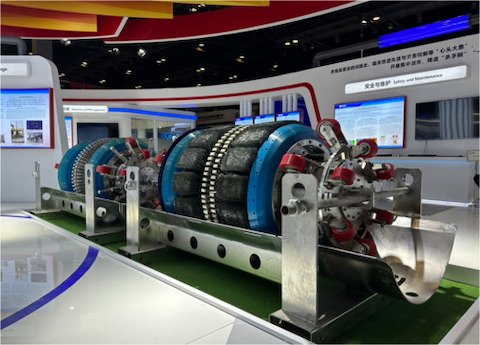
Magnetoelectric integrated in-line inspection tool developed by PipeChina.
Source: Journal of Pipeline Science and Engineering
“PipeChina’s magnetoelectric integrated inspection tool combines ultra-high-resolution sensors to identify weld defects with 90 percent accuracy for 0.3 mm defects, Chen said. “It’s a milestone for China’s domestically developed technologies.”
Meanwhile, pipeline leaks and geohazards like landslides pose severe threats to infrastructure and ecosystems.
“Real-time data fusion algorithms, integrated with supervisory control systems, allow China to achieve leak detection sensitivity as low as 1 percent of flow rate, minimizing false alarms,” Chen said.
The review also emphasizes innovations in distributed fiber-optic sensing (DFOS).
Early Warning
For geohazard management, advanced tools like satellite-based interferometric synthetic aperture radar (InSAR) and unmanned aerial vehicles (UAVs) provide early warnings of ground displacement near pipelines.
“Combining space-air-ground monitoring with AI-driven risk models allows us to predict geologic hazards and prioritize interventions,” Chen said. “The future lies in transforming conventional pipelines into intelligent networks by leveraging AI and emerging sensing technologies.”
Click here to view the research paper.