
Most of the greenhouse gases consist of methane (CH₄), nitrous oxide (N₂O), and carbon dioxide (CO₂).
The study reviewed 95 different research works and focused on evaluating the performance of sensing materials based on parameters such as sensitivity, response ratio, response time, and recovery time, said researchers Mostafa Rastgou, Yong He, and Qianjing Jiang from the Department of Biosystems Engineering at Zhejiang University in China.
For CH₄ sensors, palladium-tin dioxide nanoparticles (Pd-SnO₂) emerged as a top performer. It demonstrated excellent response time (3 s), recovery time (5 s), sensitivity (83 percent), and response ratio (17.6). This attributes to factors like high specific surface area, catalytic activity of Pd, and enhanced gas adsorption capabilities. In contrast, materials like SnO₂ nanorods-nanoporous graphene, despite having a relatively high specific surface area, showed lower sensitivity due to the absence of such effective catalytic effects.
Superior Performance
In the case of N₂O sensors, tungsten trioxide (WO₃) nanowires with a diameter ranging from 0.5 to 15 nm stood out. They exhibited a response time of 10 s, recovery time of 60 s, and an impressive sensitivity of 2690 percent to 100 ppm. Their high surface-to-volume ratio, unique morphology, and stability against humidity and temperature contributed to their superior performance.

For CO₂ sensors, barium titanate (BaTiO₃)-CuO-Ag nanocomposite structures and 400 nm nanofilms showed the best results with a response time of 3 s, recovery time of 5 s, and sensitivity of 27 percent. The large surface area, catalytic properties, and synergistic effects of the components in this nanocomposite were key factors.
The research also compared different sensing mechanisms. Resistance measurement sensors showed moderate to high sensitivity, while field effect transistor and surface acoustic wave sensors had some limitations in sensitivity range. Electrochemical sensors were highly sensitive but required regular maintenance. Gas chromatography was accurate but expensive and time-consuming. Optical sensors faced issues like signal degradation.
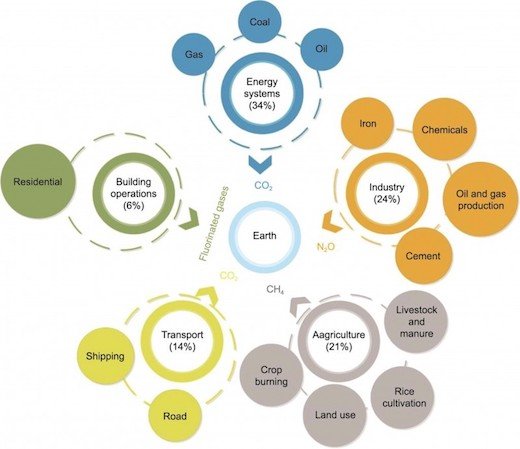
The distribution of greenhouse gas emissions across various sectors.
Source: Zhejiang University researchers
Environmental factors such as temperature and humidity also had an impact on sensor performance. Generally, an increase in temperature enhanced the reactivity of sensing materials but high humidity could increase response and recovery times. Strategies like regular calibration, temperature and humidity compensation, and proper sensor placement were suggested to optimize performance.
Efficient GHG Sensors
Overall, the study provides insights for the development of more efficient GHG sensors.By focusing on advanced materials like Pd-SnO₂ nanoparticles, WO₃ nanowires, and BaTiO₃-CuO-Ag nanocomposites, and optimizing sensor design and calibration processes, researchers can potentially improve the accuracy and efficiency of GHG detection, thereby contributing to better environmental monitoring and sustainable agricultural practices.
Click here to view the paper entitled, “An Analytical Comparison of the Performance of Various Sensing Materials and Mechanisms for Efficient Detection Capability of Greenhouse Gas Emissions.”