
That is where a new virtual reality space can help make human training faster and easier.
One task that often requires robotic help is disassembly. It’s critical for recycling parts and valuable materials from electronics nearing the end of their lifespan. However, disassembly tasks often present their own challenges, said researchers at the University of Georgia.
To that end, researchers developed VR Co-Lab to help ease confusion. By training employees digitally, not only can they practice disassembling recyclables without damaging materials, but they can also learn to avoid injury and collisions with the robot.

Humans, Robots Together
In the virtual space, users practiced taking apart a hard disk with a robot’s help.
When users put on their headset, they found themselves in a virtual workstation like what they’d encounter on the job. They saw the various tools and machinery needed for disassembly, as well as the robot helping them.
During training, workers followed a step-by-step procedure for disassembling the hard disk. Human users handled more precise tasks like unscrewing or picking and placing small bolts, while the robot arm managed larger bolts and loose items. The program also provided feedback to the user, measuring how long it took to complete the session and how many mistakes users made.
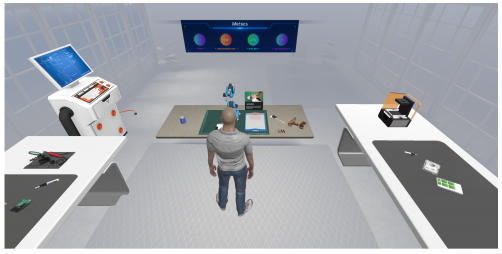
The VR Co-Lab program places users in a digital environment similar to what they may see in the workplace, where they can learn to work with robots.
Source: University of Georgia
“There are a lot of tasks. It requires a complicated training for workers, typically,” Li said. “So, if we have a VR system, that will be very helpful in shortening training time. It is much easier than having pages and pages of written documents to be read by the user.”
One key part of the VR system is body tracking.
VR Co-Lab uses Meta Quest Pro, which uses its cameras to track upper body movements in the wrists, elbows, shoulders and torso. This helps the program plan the robot’s movements based on the user’s actions, preventing collisions and improving interactivity between the human and robot.
The program warns of potential hazards that could lead to injury, such as collisions with the robot arm, while teaching users how to avoid them. The system can also figure out how quickly the robot arm can work without overwhelming the employee.
Future Work
Li and his team are planning more extensive user testing in the future to ensure the system is helpful for a variety of skill levels and applicable to tasks outside of disassembling hard disks. Improving the training process will be valuable as using robots becomes more common.
“Robots are going to be important for the future of the recycling industry because they can do a lot of disassembly steps automatically. That can help reduce the labor shortage,” Li said. “Because disassembly is so complicated, it involves a human to work together with a robot. And that’s basically our motivation for developing this VR system for training.”
Click here to view the study.