
Despite the new vulnerabilities discovered over the past year, vulnerabilities of years past continue to haunt organizations. In fact, flaws dating back to 2017 were so prominent this year Tenable Security Response Team said in its 2022 Threat Landscape Report they warranted the number one spot in the list of top vulnerabilities of 2022.
The constant evolution of the modern digital environment introduces new challenges for security practitioners. Successful security programs must take a comprehensive approach and understand where their most sensitive data and systems lay and what vulnerabilities or misconfigurations pose the greatest risk, according to the report. Given the brisk rate of digital transformation, a complete understanding of the external attack surface is paramount.
By focusing resources on the vulnerabilities that are exploitable and understanding how attackers chain vulnerabilities and misconfigurations, security teams can design more complete strategies for reducing their overall risk exposure.

In keeping with that line of thought, at the start of 2022, cybersecurity teams worldwide were still reeling from the Log4Shell vulnerability, which was disclosed in late 2021, according to the report. Now, nearing the end of the first quarter in 2023, the vulnerability — which affected Apache Log4j, a widely used Java logging library — remains a key concern. In fact, Tenable researchers analyzed a representative sampling of telemetry data and found that, as of October 1, 2022, the vast majority of organizations (72 percent) remain vulnerable to Log4Shell. Even more concerning, 29 percent of vulnerable assets saw the reintroduction of Log4Shell after they achieved full remediation.
Key takeaways from the report include:
Ransomware attacks intensify, exposing reams of data: 2.29 billion records were exposed in 2022. Ransomware continued its domination, accounting for over 35% of data breaches
Cloud misconfigurations affect even the most mature organizations: Microsoft and Amazon experienced breaches of sensitive customer information due to misconfigurations in their own cloud environments. While these incidents did not put customer environments at risk, they demonstrate the importance of minding configurations. Over 3% of all data breaches in 2022 were caused by unsecured databases, accounting for leaks of over 800 million records.
Supply chain vulnerabilities continue to haunt organizations: Organizations are still contending with the fallout from the Log4Shell vulnerability, disclosed late in 2021, while more vulnerabilities in common libraries and dependencies were disclosed. More than anything, the heightened responses required from IT, security and engineering teams have been extremely disruptive to security operations in 2022.
Macro factors spur refinements in threat actor behavior: Ransomware remained the largest concern for organizations when reckoning with the threat landscape in 2022, but the groups engaging in these attacks continued to refine their tactics and tools. Geopolitical tensions and nation-state activity also influenced enterprise cybersecurity considerations to a lesser extent.
Conclusions Tenable reached in the report found users should address known vulnerabilities, which is the most effective thing you can do right now. “We issued this same warning in 2020 and in 2021. Yet, two years later, such flaws remain one of the biggest risks in the vulnerability landscape. Unpatched vulnerabilities provide attackers with the most cost effective and straightforward way to gain initial access into or elevate privileges within organizations. Don’t wait. Identify which assets in your environment are exposed to the vulnerabilities listed in this report as soon as possible,” researchers said in the report.
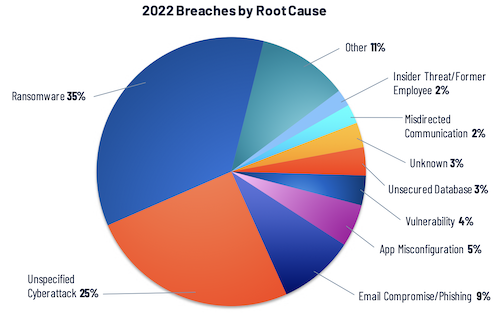
Ransomware remained the most common root cause for breaches at organizations last year, accounting for 35.4 percent of all breach events. This is a slight decrease from 2021 where ransomware was at 38 percent.Source: Tenable
In addition, everyone should ignore the hype and focus on assessing your environment. The 2020 incident at SolarWinds and the 2021 Log4Shell vulnerability have had a lasting impact on how the industry reacts to supply chain issues. Researchers, journalists and, by extension, executives and boards are consumed with waiting for the “next Log4Shell” to drop. Organizations must examine the specific details of vulnerabilities, when available, to assess the true potential impact, rather than speculative. The key to protecting your networks is the ability to quickly appraise every facet of your environment to identify all assets and assess your code base.
Also, ransomware attacks haven’t slowed, and neither should our efforts to contain them. Ransomware itself is a profitable business venture for the various players in the ecosystem and we can’t judge ransomware activity based solely on the entries on data leak sites. Active Directory is the key to most successful ransomware breach events, therefore organizations must harden their AD environments against ransomware attacks.
In another issue, misconfigurations and human error continue to pose significant risks in the cloud. With best practices guides, hardening tips and more released by CSPs, government organizations and vendors alike, ultimately it remains up to the users of cloud and container products to follow and adhere to these resources. Human errors in configuration and implementation, rather than vulnerabilities, pose some of the greatest risks in the cloud.
Organizations moving to the cloud need to continuously examine their containers and deployment scripts in order to ensure their deployments meet and exceed their security thresholds. To mitigate these risks, we advise security teams to adopt cloud security posture management (CSPM) solutions. CSPM establishes a secure design and baseline configuration for assets in the cloud. By starting with a secure baseline as the building block, an organization can preemptively address concerns with user and access management and ensure that regulatory compliance is maintained as new services and environments are spun up.
Click here to review the entire report.