
The incident occurred while the workers were on scaffolding and unbolting a 10-inch flange, according to an investigation by the Bureau of Safety and Environmental Enforcement (BSEE). After determining the skillet was the wrong size, the supervisor instructed a third worker to join the initial two workers on the scaffolding to take measurements of the skillet to verify the pipe size.
Upon arrival, the third worker saw the other two had already unbolted the flange to install the skillet. The third worker instructed them to pass down the gasket so he could verify the pipe size, then exited the scaffolding and relocated to the tool shed to retrieve a fall protection harness.
Simultaneously, they heard pressure escaping between the pipe flange opening. The third worker, who was still in the tool shed, heard a rumbling sound and loud noise, and looked in the direction of the noise to see a black plume of smoke.

The third worker noticed the other two workers were suffering from exposure to the material being emitted from the gap in the parted flange. The two workers on the scaffolding experienced smoke inhalation and described feeling a burning sensation. They ended up transported to the nearest hospital by air transport for further evaluation.
On Sept. 16, 2022, BSEE personnel conducted an on-site investigation and searched for any isolation sources near the verified isolation points. They found no isolated sources or ignition sources in the incident area. BSEE also determined workers properly installed all equipment per the hazardous area classification drawings. In addition, BSEE inspected the tools and equipment personnel on board reported using and determined these were correctly rated for the area.
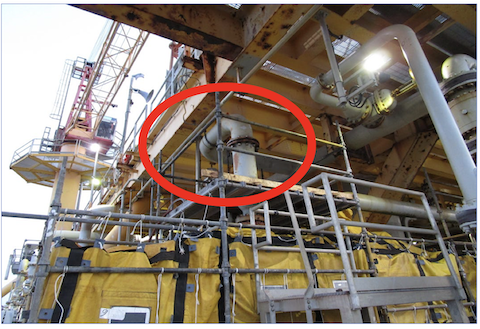
Worksite with flange and scaffolding where workers were installing the skillet.Source: BSEE
The BSEE incident investigation found:
- Workers were not aware of the possible hazards within the piping
- No purging or flushing of the piping occurred before the work was done
- Personnel failed to identify the possibility of pyrophoric materials within the piping
As a result of its findings, BSEE recommends operators and contractors consider the following:
- Implement and follow a fire and explosion management plan and safe work procedures when working with tanks and vessels where pyrophoric iron may be present. The plan and procedures should address ignition sources, oxygen, and fuel sources.
- Identify possible ignition sources, including pyrophoric materials that can form in both sour and sweet sites, automatic flare stack igniters, electrical discharge from improper bonding/grounding, and lightning.
- Determine how oxygen could enter the tank through possible entry points like the thief hatch, extinguished flare stack, open valves, pipes, and hatches.