
To that end, the Chemical Safety and Hazard Investigation Board (CSB) released a safety study entitled “Remote Isolation of Process Equipment” issuing recommendations to regulators and calls for greater use of remote isolation equipment at chemical facilities.
Based on the agency’s investigations of catastrophic chemical incidents, the CSB’s safety study concludes the chemical industry has not fully recognized effective remote isolation of process equipment is critical to quickly stopping releases of hazardous materials.
Over the last several years, the CSB reviewed and investigated chemical incidents where the consequences escalated dramatically following a loss of containment due to the lack of effective remote isolation equipment. The CSB highlighted the following investigations in the safety study:
Formosa Plastics Propylene Explosion (2005): Sixteen workers suffered injuries, the process unit had heavy damage, and a nearby school evacuated.
Valero McKee Refinery Propane Fire (2007): Four workers suffered injuries and the refinery ended up evacuated and shut down for several months.

Intercontinental Terminals Company (ITC) Tank Fire (2019): Estimated property damage exceeded $150 million, 21 million gallons of hazardous material and contaminated water released into nearby waterways, there were shelter-in-place orders for nearby communities due to benzene-related air quality concerns, and local schools and businesses either closed or operated under modified conditions.
KMCO Fatal Fire and Explosion (2019): One fatality and two serious injuries resulted, portions of the facility ended up substantially damaged, and the explosion reportedly shook nearby homes and residents could heard the blast throughout the surrounding community.
Philadelphia Energy Solutions (PES) Refinery Fire and Explosions (2019): Roughly 676,000 pounds of hydrocarbons and over 5,200 pounds of highly toxic hydrofluoric acid released, the estimated property damage loss was $750 million, and the refinery ultimately closed permanently.
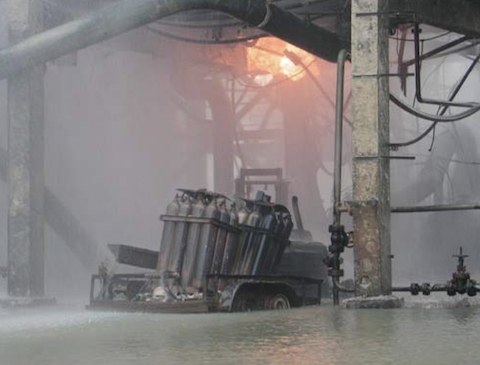
The Formosa Plastics Propylene Explosion in 2005 where 16 workers suffered injuries and the process unit experienced heavy damage.Source: CSB
TPC Group Port Neches Explosion and Fire (2019): Residents felt the explosion up to 30 miles away, caused $450 million in on-site property damage and $153 million in off-site property damage to nearby homes and businesses, propelled a process tower at the facility into the air, and resulted in a fire that burned for more than a month within the facility.
After investigating the incidents and conducting the study, the CSB issued three safety recommendations, one each to the American Petroleum Institute (API), the Environmental Protection Agency (EPA), and the Occupational Safety and Health Administration (OSHA):
- American Petroleum Institute: Revise its industry guidance documents to apply to more facility types beyond refineries and include requirements for remote isolation devices should for when they should end up automatically activated or remotely activated from a safe location, for processes involving highly flammable or toxic materials and atmospheric storage tanks.
- Environmental Protection Agency: Incorporate requirements for an evaluation of the need for remote isolation capabilities into its Risk Management Program (RMP) Rule, which regulates processes involving highly flammable or toxic materials.
- Occupational Safety and Health Administration (OSHA): Include requirements for an evaluation of the need for remote isolation capabilities into its Process Safety Management (PSM) standard, which regulates processes involving highly hazardous chemicals.
These recommendations could enhance safety measures and mitigate the consequences of incidents like the explosions and fires at chemical facilities by ensuring that necessary and safe remote isolation capabilities are in place to prevent the escalation of releases of hazardous materials.
Act Before Requirements
In addition to the recommendations, the CSB is calling on chemical facilities to immediately assess whether they should apply remote isolation to major process equipment even before formal requirements are put in place in industry standards and federal regulations – and if so, install effective remote isolation equipment in a location that is safe for workers to activate.
On a global scale, major incidents have led to the development of robust guidance for facilities to assess whether they need remote isolation, along with detailed steps for implementation.
As such, the CSB found the industry needs to take additional action.
The API should improve existing voluntary standards by establishing criteria for various facility types including petroleum refineries as well as chemical petrochemical facilities with major process equipment and atmospheric storage tanks, that details conditions to necessitate the installation of remote isolation devices that may be automatically activated or remotely activated from a safe location during an emergency.
Additionally, while there is a need for strong industry standards, there is a necessity to fill regulatory gaps.
EPA and OSHA must implement regulatory requirements for the critical review of major process equipment to determine whether the consequences from a major loss-of-containment event can be significantly reduced by safe, rapid, and remote isolation of process equipment following a release.
By systematically evaluating process equipment and applying remote isolation equipment to mitigate major loss-of-containment events, companies can save lives, protect jobs, protect the environment, and safeguard critical infrastructure vital to the economy.
Click here to review the CSB study.