
Industrial AI has moved from a future consideration to active deployment, with 61 percent of organizations now using AI in live industrial operations where performance, reliability, and security have direct physical consequences, and 20 percent reporting scaled, mature deployments, according to Cisco which just released its latest annual industrial research report, the State of Industrial AI Report, examining how critical infrastructure like factories, utilities, and transportation systems are accelerating their direct deployments of AI.
The report provides a data driven view into how industrial organizations are adopting AI, the challenges they face as AI moves into live operations, and the opportunities created as AI becomes embedded in physical systems, infrastructure, and workflows. The double-blind global study surveyed more than 1,000 operational technology (OT) decision makers across 19 countries and 21 industrial sectors.
AI in Production
“Industrial AI is moving from experimentation into production, where AI systems sense, reason, and act in the real world,” said Vikas Butaney, senior vice president/general manager of Secure Routing and Industrial IoT at Cisco. “At this stage, success is no longer determined by models alone, but by whether networks, security, and teams are ready to support AI at the edge, in motion, and at scale. The research shows that organizations confident in scaling AI are those treating infrastructure, cybersecurity, and IT/OT collaboration as foundational, not optional.”
Across manufacturing, transportation, and utilities, AI is powering machine vision, robotics, mobility, and safety critical operations.

Most organizations plan to increase AI spending (83 percent), and nearly nine in ten expect meaningful outcomes within the next two years (87 percent). Yet as adoption accelerates, many are struggling to sustain and expand deployments, with readiness across network infrastructure, security, and skills increasingly determining whether AI can scale consistently across core physical environments.
When it comes to the manufacturing sector, industrial AI demands network modernization where AI implementation is placing unprecedented demands on manufacturers’ underlying infrastructure. Issues in networking include:
- 56 percent said unreliable wireless connectivity frequently disrupts manufacturing operations
- 96 percent said wireless connectivity is critical to AI success
- Reliable connectivity (49 percent), edge compute (44 percent), and bandwidth (39 percent) are top network requirements for AI at scale
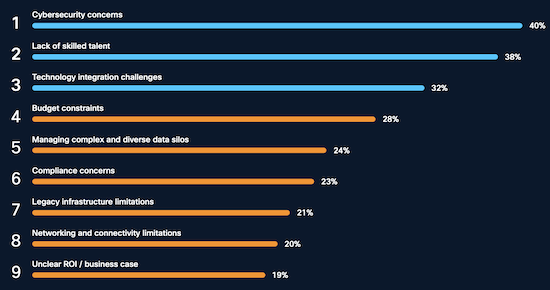
When asked what are the biggest obstacles your organization faces in adopting AI? Cybersecurity was the top issue.
Source: Cisco
Network readiness now determines AI success, with infrastructure limitations directly constraining the ability to scale deployments.
Cybersecurity a Barrier
When looking at what is holding back AI implementation, cybersecurity is the top barrier and the top asset as expanding AI adoption elevates cybersecurity risk:
- 98 percent said cybersecurity is foundational for AI-ready infrastructure
- 40 percent cite cybersecurity concern as the top barrier to AI adoption
- 46 percent said security is the biggest networking challenge for AI-enabled operations
- 81 percent expect AI to improve their cybersecurity posture
While security gaps are limiting AI scale today, manufacturers view AI as a tool to strengthen detection, monitoring, and resilience.
As it is in most manufacturing environments, IT/OT collaboration is critical, especially when it comes to creating AI at scale where effective collaboration between IT and OT teams directly impacts AI outcomes:
- 43 percent of manufacturing organizations show little to no IT/OT collaboration
- 34 percent cite lack of collaboration between IT and OT teams as a major challenge limiting AI-enabled operations
- 28 percent said OT domain expertise is critical to scaling AI
While disparate teams slow AI deployment and increase operational risk, IT/OT alignment accelerates scalability, stability, and security.
Click here for the State of Industrial AI for Manufacturing report.