
Having said that, there are still opportunities to improve burning efficiencies and further reduce adverse environmental impacts. Compared to traditional ISB using a pool fire configuration, fire whirls have been shown in laboratory studies to intensify the combustion process of oil spills and, under the right conditions, increase the burning efficiency and decrease atmospheric emissions.
In a project testing the fire whirl capabilities, researchers at the Bureau of Safety and Environmental Enforcement (BSEE) performed laboratory small-scale and outdoor large- scale experiments to characterize the effects of fire whirls versus pool fires and slick thickness on burning efficiencies and emissions.
Fire Whirl Configurations
Investigations assessed the configuration and dimensions that can most effectively form fire whirls over liquid fuels at the laboratory scale, where systems with three or four walls ended up arranged to restrict airflow to the azimuthal direction around a central pool of n-heptane as a surrogate fuel.

Researchers saw the height and side length of the enclosure had an impact on the dynamics and formation of fire whirls, thus these parameters varied compared to a fixed fuel pool diameter to assess any change in the flame length and burning rate.
Optimal combinations of parameters from these experiments then ended up assessed in terms of their effects on particulate emissions and modified combustion efficiency.
The obtained results in this study, conducted by Michael Gollner, Mohammadhadi Hajilou, Joseph Dowling, and Wuquan Cui from the University of California, Berkeley and Elaine Oran and Qingsheng Wang from Texas A&M University, confirm the feasibility of using fire whirls with a three-wall setup for more efficient in-situ burning of crude oil spills and provide valuable information on the properties of fire whirls for deployment in the field.
In addition, laboratory experiments showed the effect of slick thickness on the burning efficiency and emissions of crude oil.
To that end, researchers conducted experiments on three oil slick thicknesses, 3.8 mm (30 ml), 7.6 mm (60 ml) and 11.5 mm (90 ml), in a 10 cm diameter container with a water sublayer using HOOPS and ANS crude oil.
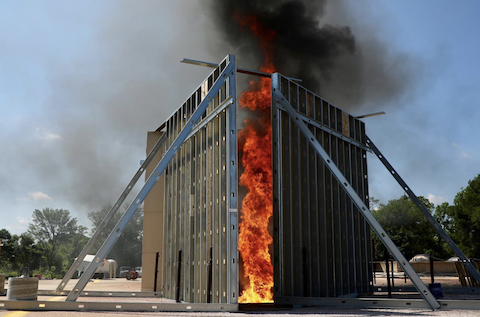
A test of a whirling fire, which could possibly intensify the combustion process of oil spills and, under the right conditions, increase the burning efficiency and decrease atmospheric emissions.
Source: Wuquan Cui
Types of Measurements
With all that, researchers measured the mass loss rate, gas and particle emissions, temperature of the oil and water sublayer, and flow rate and temperature of the effluence for pool fires and fire whirls.
In addition, a large-scale experiment occurred at the TEEX Brayton Fire Training Field in Texas where researchers successfully conducted the largest to-date fire whirl experiments in an outdoor environment. Two oil slick thicknesses, 15 mm and 40 mm, ended up studied by using HOOPS crude oil, set inside a 1.5 m diameter metal ring suspended at the surface of a large water pool.
Measurements included temperature measurements of the flame, oil layer and water layer, heat flux measurements near the pool center and on the side, air entrainment velocity, and particle and gas emissions.
During the experiment, cameras to video from four different angles and drone footage from overhead. At all scales researchers found that compared to pool fires, fire whirls significantly increased the burning rate, while also reducing PM2.5 emissions.
Also, by increasing the slick thickness from 3.8 mm to 11.5 mm in the laboratory, the burning rate increased more than 50 percent in fire whirls, with only a small change in pool fire conditions.
Fuel Consumption Efficiencies
Increasing the slick thickness in the laboratory also results in an increase in fuel consumption efficiency; nonetheless, it also increased emissions of PM2.5. In the field, there were fuel consumption efficiencies of over 90 percent, however, for many fire whirl tests premature extinguishment of the ISB lowered ultimate fuel consumption efficiencies.
These experiments helped provide experimental evidence assessing the scalability, robustness, and efficiency of fire whirls in cleaning spilled oil.
Click here for more on the fire whirl report.