
An incident involved the separation of a section of fiber reinforced plastic pipe (FRP) from its flange on an offshore rig.
As a safety precaution, production immediately halted to investigate the situation, according to a report with the Bureau of Safety and Environmental Enforcement (BSEE).
During the inspection, the team discovered that a segment of 10-inch FRP piping had disengaged from its attached flange, resulting in a 4-inch pipe also becoming detached due to the movement of the 10-inch pipe, according to the report.
To address the issue, workers isolated the affected fire loop main from the rest of the system, allowing the remainder of the system to resume normal operation. Workers quickly conducted repairs on the fire main, and once they completed the necessary repairs, production at the facility resumed.

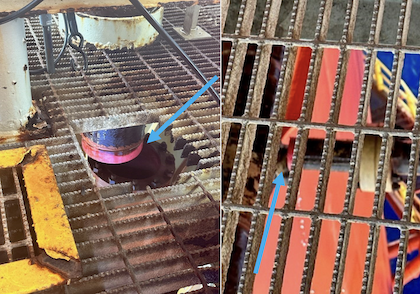
The operator identified a bond failure as a potential cause of the separation, which they subsequently addressed to prevent any reoccurrence.
As a result of the incident, recommends operators and contractors consider the following:
- Reviewing preventative maintenance records and ensuring adequate inspection and routine checks of firefighting equipment.
- Providing instructions, training, competency assessments, and proper supervision to operators and maintenance personnel.
- Testing, if possible, the connection between the FRP pipe and flange to ensure an adequate seal.
- Visually checking for leaks while the mains are pressurized during routine firewater system tests. According to regulations for fire water systems (as per API RP 14G 4th Edition, Section 5.2), it is essential to maintain sufficient pressure (a minimum of 75 psig) when hose streams are flowing, unless the nozzle manufacturer specifies higher pressure requirements. Even a fire water system with small leaks may initially meet the pressure requirement, but addressing smaller leaks promptly can prevent more significant failures from occurring.
Fiber reinforced plastic pipes separated from flanges.
Source: BSEE