
Having said that, integrating complementary information while eliminating redundancy or multi-sensor fusion has long been key to improving diagnosis accuracy. However, existing studies have two flaws: They either ignore multi-sensor relations (MSRs) or only use them to enhance fault type recognition (failing to fully exploit MSR value), and rarely address multi-source fault localization.
For devices like induction motors and centrifugal pumps, single faults may link to multiple sources, so accurate localization is vital for maintenance, making existing methods unable to meet the demand for simultaneous fault recognition and localization, according to a study by researchers Shuhui Wang, Yaguo Lei, Na Lu, Xiang Li, and Bin Yang from Xi’an Jiaotong University, Xi’an, China. To solve this, the team conducted a study and wrote a research paper, entitled, “A multi-sensor relation model for recognizing and localizing faults of machines based on network analysis.”
The study proposes a global fault diagnosis (GFD) method based on MSRs and network analysis, including two core stages: Fault recognition and localization.
For fault recognition, an MSR model ended up developed to automatically learn MSRs and recognize faults. Unlike traditional graph neural networks (GNNs) that need pre-defined noise-sensitive graph structures, the MSR model combines graph structure learning and dynamic graph learning.

Converts Sensor Signals
In graph structure learning, a latent edge-type encoder (via transition matrices/one-hot encoding) converts sensor signals from vertex to edge domain, with multi-layer perception for feature embedding; Gumbel softmax samples from latent edge-type probability distributions to get real edge types, avoiding manual graph construction.
In dynamic graph learning, convolution extracts temporal features of sensor signals, message passing (based on real edge types) aggregates/updates node features, an attention mechanism calculates edge-type attention scores to select the most informative MSR graph, and multi-layer perception gives fault labels.
For fault localization, network analysis centrality measures (degree centrality, which counts node direct connections to find critical nodes; eigenvector centrality, which considers node and neighbor importance) end up applied to the MSR model’s learned MSR graphs. Moreover, the node with the highest centrality ends up identified as the fault source, realizing accurate multi-source fault localization.
Extensive experiments on induction motors and centrifugal pumps show the method’s excellent performance.
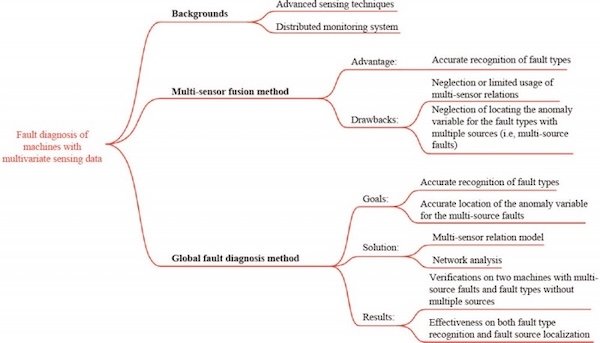
Graphical abstract shows the concept of a global fault diagnosis method based on multi-sensor relations and network analysis, including two core stages: Fault recognition and localization.
Source: Shuhui Wang, Yaguo Lei, Na Lu, Xiang Li, and Bin Yang
For induction motors (tested under four health conditions: Normal (NC), broken rotor bar (BRB), unbalanced voltage supply (UVS), open phase fault (OPF)), the MSR model achieves 0.9980 average classification accuracy (superior to GCN, GAT, SGC, HGN—models sensitive to pre-defined graphs with unstable accuracy).
In localization: For UVS (W-phase as fault source) and OPF (V-phase as source), centrality analyses accurately identify W/V-phase as critical nodes (matching settings); for BRB, the critical node is the fan-end vibration sensor (matching actual rotor bar defect location).
Centrifugal Pumps
For centrifugal pumps (five health conditions: NC, cavitation (CF), inner race (IF), outer race (OF), ball faults (BF)), the MSR model maintains 99.21 percent average accuracy (outperforming compared graph models).
In localization: for CF (flow rate as source), centrality identifies the flowmeter (N4) as critical (matching cavitation simulation via valve-adjusted flow rate); for bearing faults (IF, OF, BF), critical nodes end up accurately located at the bearing sensor (N2), verifying the method’s stability and adaptability.
The research results provide a new technical framework for multi-source fault diagnosis of mechanical devices, greatly promoting the development of intelligent fault diagnosis technology that integrates fault recognition and localization.
In the manufacturing, energy, and transportation sectors, where induction motors, centrifugal pumps, and other mechanical equipment see wide usage, this achievement can significantly improve the accuracy and efficiency of fault diagnosis, help formulate targeted maintenance strategies, reduce maintenance costs, avoid serious equipment failures caused by missed or misdiagnosed faults, and thus facilitate the safe and stable operation of industrial systems and the high-quality development of related industries.
Click here to see the paper entitled, “A multi-sensor relation model for recognizing and localizing faults of machines based on network analysis.”