
Manufacturing remains a favorite target for ransomware groups as it tops the list for the fourth consecutive year, according to the 2025 Manufacturing Report: Why Your Supply Chain is Your Biggest Cyber Risk from Black Kite.
Cybercriminals are deliberately targeting this industry because they know its operational continuity is critical and any disruption can cause a cascading effect through global supply chains. This is particularly true for high-value targets, as manufacturing accounts for 38.9 percent of ransomware victims among companies earning over $1 billion, according to the report.
Easily Exploitable Weaknesses
The report also found the industry has significant and easily exploitable weaknesses. It found 75 percent of manufacturing companies have critical vulnerabilities with a CVSS score of 8 or higher. Furthermore, 65 percent have at least one vulnerability listed in the Cybersecurity and Infrastructure Security Agency (CISA) Known Exploited Vulnerabilities (KEV) Catalog, which means these are already undergoing active exploitation by attackers.

There also appears to be a widespread neglect of basic cyber hygiene when looking at the poor grades in areas like patch management and application security, according to the report.
Patch management is a fundamental component of a secure infrastructure, yet the research reveals a concerning trend of poor performance across the manufacturing sector. Moreover, the data shows the majority of companies across all sub-industries scored poorly in this area, indicating assets have outdated and vulnerable servers or products. This widespread neglect of timely patching leaves companies susceptible to data breaches and other cyber threats.
As mentioned, data shows the number of ransomware attacks on manufacturing companies keeps climbing, with a 9 percent increase compared to last year. A significant driver of this is the supply chain. Not only are larger enterprises a target, but new and smaller ransomware groups are targeting smaller contractors to gain a foothold in the larger manufacturing ecosystem, according to the report.
This “contractor weak link” strategy allows attackers to bypass the more robust defenses of larger manufacturers by exploiting their less secure third-party suppliers.
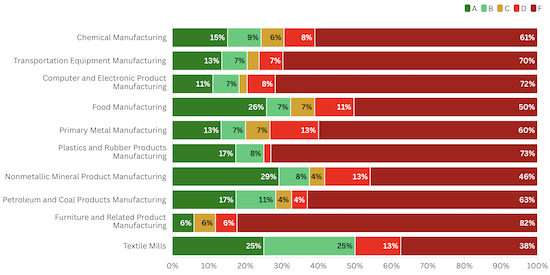
Percentage of grades for patch management.
Source: 2025 Manufacturing Report, Black Kite Research Group
Lessons Learned
With those highlighted weaknesses, the report found at least four key lessons learned:
Proactive third-party cyber risk management is vital. You cannot protect your organization without understanding and managing the risks posed by your entire supply chain. Attackers are using your suppliers as an on-ramp to your network. This means you must have a robust third-party risk management program that goes beyond simple vendor questionnaires. You need to identify, assess, monitor, and mitigate risks across your entire third-party ecosystem.
Focus on cyber hygiene. The high percentage of companies with critical vulnerabilities and poor patch management is a sign they are neglecting basic security controls. Cybersecurity leaders must expand their focus from just their own network’s hygiene to the hygiene of their entire supply chain.
View risk like the adversary. Predictive risk metrics reveal every manufacturing sub-industry carries an average susceptibility score that places them in the critical risk category of experiencing a ransomware attack. The ability to forecast which of your suppliers are most likely to suffer a ransomware attack is a strategic asset, allowing you to proactively mitigate risk and prevent a major disruption to your production line.
Threats have evolved, and so should your defense. The ransomware landscape is becoming more fragmented and unpredictable, with new groups emerging and using tactics like AI-assisted reconnaissance and double-targeting of victims. This means you need a dynamic, intelligence-led approach to security. Tools that combine supply chain monitoring with early warning signals are essential for staying ahead of these evolving threats and protecting your business and operational stability.
Click here for more on the report.