
Using an advanced version of sintering, called Electric Field Assisted Sintering (EFAS), it is now possible to manufacture parts for durability and to withstand harsh environments like nuclear reactors, concentrated solar plants, geothermal systems, armor, and even aerospace applications, said researchers at Idaho National Laboratory (INL).
EFAS systems rely on rapid joule heating, which sends electricity through two large metal presses on either side of the material, and sometimes the material itself, to fuse the particles of powdered metals, ceramics or a mixture of both. This is the same mechanism as an incandescent lightbulb: Electric current passes through a tungsten filament, which eventually heats enough to glow.
CEFAS Created
INL researchers just invented, built and commissioned a new EFAS technology, known as Continuous Electric Field Assisted Sintering (CEFAS), funded by the Department of Energy’s Advanced Materials and Manufacturing Technology Office.

All EFAS instruments, including the CEFAS, sinter materials by applying pressure and heat. CEFAS differs from other EFAS instruments because it sinters materials continuously rather than in batches.
“The CEFAS is unique among all EFAS technologies as it is the only instrument capable of producing parts continuously,” said Andrew Gorman, a materials scientist leading CEFAS development. “By shifting from a batch to a continuous process, the CEFAS has the potential to increase part production by a hundred-fold compared to batch EFAS.”
In traditional EFAS, samples typically end up placed into a mold located between two giant metal presses known as rams. Electrical current passes through the rams into the mold, which heats the mold while the rams simultaneously apply pressure on the material. This squeezes the material, removing all air space and molding it into a cohesive part. In contrast, the CEFAS passes material through two rotating graphite rollers heated using the same physics leveraged in traditional EFAS, allowing for samples of unlimited length.
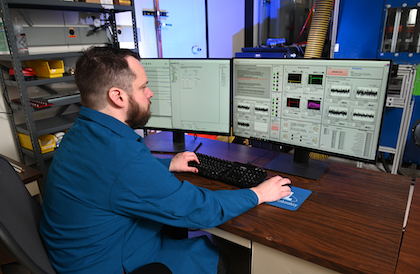
Materials Scientist, Andrew Gorman, analyzes data from the CEFAS.
Source: INL
Pivotal Technology
“The CEFAS has the potential to be a pivotal technology in advanced materials manufacturing across multiple industries,” Gorman said. “There are materials processed today that require days or weeks in a furnace. Even if it required multiple passes through the CEFAS, the cost, energy requirements and carbon emissions would drastically reduce.”
The CEFAS has successfully reached temperatures needed to process several materials. Going forward, the CEFAS team will produce samples to demonstrate the machine’s capabilities.
“We know that the CEFAS will excel in traditional EFAS application areas, but with the unique heating profiles and continuous process, there could be new applications that we don’t yet know about,” Gorman said. “It feels like we’re just scratching the surface with the CEFAS’ potential.”