
“Fire booms are specialized containment booms designed to not only corral floating oil but also to withstand the high temperatures generated when the contained oil is burned in place. Fire booms can be reused for multiple in situ burn activities,” said Harry Juneau, a senior preparedness analyst, in the BSEE Preparedness Verification Branch in the Gulf of Mexico Region Office. “The ability of an offshore facility owner/operator to respond effectively to an oil spill is directly related to the preparedness state of the equipment listed in their OSRP.”
Preparedness verification is one of the three essential roles of BSEE’s Oil Spill Preparedness program. BSEE must ensure owners and operators of offshore oil facilities are trained and equipped to respond to oil spills from the time they drill their first well until the last platform is removed.
BSEE personnel periodically audit industry-led trainings and exercises to ensure they are ready to respond to incidents.

Each fire boom system is designed to burn pooled oil to augment mechanical recovery, or when mechanical recovery may not be possible. Fire booms are most effective when deployed as soon as possible after a spill occurs, so volatile compounds can be utilized to ensure the effectiveness of the burn. Oil can be ignited only once approval has been obtained from the federal On-Scene Coordinator and a wildlife observer verifies there are no animals within the burn area.
Several tons of oil an hour can be burned while the operation is monitored for burn control and safety. Once the burn is complete, any residue left over must be disposed of in accordance with a written disposal plan.
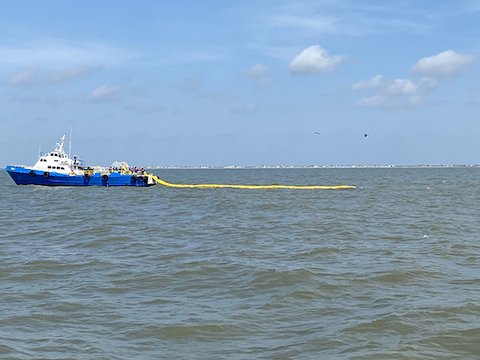
The MV Erin T deploys a 500-foot section of 32-inch water-cooled fire-retardant boom approximately three miles off the coast of Point Bolivar, Texas, during an exercise to evaluate the capability of Lobo Operating, Inc. BSEE routinely assesses an organization’s oil spill response plan.
Source: BSEE
Clean Gulf Associates worked with T&T Marine on behalf of Lobo Operating to conduct the exercise.