
This initiative seeks to support small and medium enterprises (SMEs) in enhancing safety management within high-risk industrial environments, said Korea Institute of Civil Engineering and Building Technology (KICT) President Kim Byung-Suk. It also aims to facilitate real-time detection of hazardous gases in the field, ensuring compliance with the Occupational Safety and Health Act (OSHA) and the Serious Accidents Punishment Act (SAPA), which are two important pieces of legislation in South Korea.
The new hazardous gas detection technology developed by KICT is over 50 percent smaller than existing products and features optimized fluid dynamics to enable rapid gas intake, reducing detection time while minimizing pollutant ingress, thus significantly enhancing detection accuracy and sensitivity.
The modular design also allows for easy sensor replacement or addition, making it adaptable to diverse environmental applications.

A key differentiator of this technology is its capability to deliver high-performance domestic equipment, in contrast to the foreign-made products currently dominating the Korean-market. Existing products are often large, heavy, and lack communication features, making remote monitoring and integrated data management challenging.
The developed technology supports a range of communication protocols, including BLE, Wi-Fi, and LTE, enabling real-time remote monitoring and immediate alerting of dangerous situations. It also supports integrated management via a cloud-based monitoring server and mobile app, allowing for swift responses in emergencies, and data accumulation can aid in future accident prevention and response planning.
KICT’s miniaturized and modular hazardous gas detection technology is in the process of undergoing commercialization in partnership with PiQuant, an indoor air quality IoT solution company based in Korea.
This partnership aims to offer a cost-effective solution that can replace expensive foreign-made equipment, making hazardous gas monitoring systems more accessible for small manufacturing sites with fewer than 50 employees.
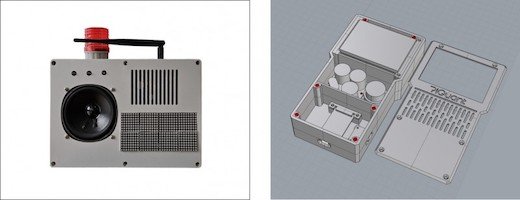
Existing gas detector, left, and newly designed detector design currently in development, right.
Source: Korea Institute of Civil Engineering and Building Technology
Moving forward, KICT plans to strengthen the predictive capabilities of monitoring through data analysis using AI and machine learning (ML) and to apply Computational Fluid Dynamics (CFD) simulations to develop customized solutions optimized for various industrial environments.
“KICT continuously supports projects to enhance the technological capabilities of small and medium-sized enterprises,” said Dr. Lee, Jaiyeop from Korea Institute of Civil Engineering and Building Technology.
He added this technology should extend its application range from construction sites to sewer work sites, factories, and other hazardous environments, contributing to overall industrial safety management.