
First, the underwater acoustic environment is inherently complex—characterized by narrow bandwidth and significant transmission delays—which causes discrepancies between the measured target position and its actual position, undermining tracking accuracy.
Traditional delay-handling methods, such as particle filter-based or unscented Kalman filter (UKF)-based approaches, rely on extensive particle simulations or unscented transformations, demanding high computational power that exceeds the capabilities of ordinary USN nodes.
Second, USN nodes face severe energy constraints: Their batteries are non-replaceable, and fixed-node topologies limit coverage and tracking stability, while existing energy-saving strategies focus primarily on fixed USNs and lack in-depth exploration of collaboration with autonomous underwater vehicles (AUVs) – which possess superior mobility and computing power, and can surface for recharging.
To that end, a research team composed of researchers from the Ocean College at Jiangsu University of Science and Technology, the Electrical and Electronic Engineering Department at Auckland University of Technology, and the Wuhan Maritime Communication Research Institute has conducted a study entitled “Joint target tracking using an autonomous underwater vehicle and underwater sensor networks for underwater applications.”

Joint Tracking Method
This study proposes a joint target tracking method integrating AUVs and USNs to address the challenges, with two core innovations.
First, to mitigate the impact of underwater acoustic transmission delays, a time-delay compensated centralized extended Kalman filter (TD-CEKF) algorithm ended up designed.
Unlike particle filter or UKF methods, TD-CEKF directly incorporates transmission delay corrections into the centralized Jacobian matrix calculation: it first computes the delay based on the angles of acoustic pulses at USN nodes and the target, then corrects the target’s predicted state and measurement residuals using this delay, avoiding time-consuming particle simulations while ensuring accurate delay compensation.
Extensive simulations show that compared with time offset estimation UKF (TO-UKF) and time delay estimation particle filter (TD-PF) algorithms, TD-CEKF maintains lower root mean square error (RMSE) (stabilizing at 1.2–1.5 m after the 20th time step under typical target speeds) and is less affected by initial estimation errors, with execution time orders of magnitude lower than TD-PF.
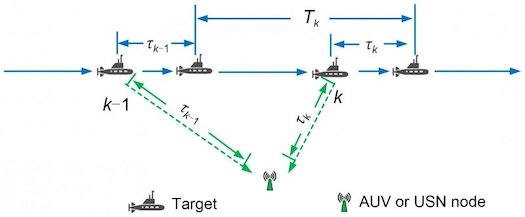
Schematic diagram of measurement delay.
Source: Credit: Zhaohong Lv and team
Second, to optimize USN topology and enhance tracking stability while reducing USN energy consumption, the study leverages AUV mobility.
It first establishes a mathematical relationship between AUV position and the Fisher information matrix (FIM) – a key indicator of tracking accuracy – showing AUV position adjustments directly affect the lower bound of target state estimation error.
Then, a penalty function ends up introduced to convert the constrained AUV position optimization problem (limited by AUV speed and sampling interval) into an unconstrained one, and the gradient descent method ends up used to search for the optimal AUV position that maximizes FIM (minimizing tracking error).
Higher Accuracy
Simulations confirm that compared with fixed USN tracking, the AUV-USN joint method achieves significantly higher accuracy (RMSE increasing only slightly from 0.92 m to 2 m as process noise variance rises from 10<sup⁻⁴ to 10⁻², versus a 1.15 m to 5 m increase for fixed USNs) and stronger noise immunity.
Additionally, the AUV acts as a fusion center, reducing the number of active USN nodes and their computational load, thereby extending USN lifespan – with the additional execution time for AUV position search remaining negligible.
Click here for the paper entitled, “Joint target tracking using an autonomous underwater vehicle and underwater sensor networks for underwater applications,” authored by Zhaohong Lv, Zhenkai Zhang, Boon-Chong Seet, and Yi Yang.