
To that end, a new approach is in development that will be able to explore the higher-dimensional shape of cyber systems to identify signatures of adversarial attacks, according to a team of researchers at Pacific Northwest National Laboratory (PNNL).
The researchers tested the approach on a publicly available dataset used to study advanced persistent threats (APTs) that aim to steal sensitive data through multiple stages, such as an intrusion through a phishing email that expands access to network data over time.
Data Flows Perspective
To get a different perspective on the data flows in cyber systems, and thus hunt for behaviors that could be malicious, Purvine and her colleagues devised a framework based in the mathematical theories of hypergraphs and topology that allows them to explore data in cyber networks in higher dimensions through topological signatures.

Hypergraphs can model systems where groups of things interact or share common behaviors or properties. Purvine likens them to bunches of proteins in a cell that act together to form a reaction, or social networks where groups of people form clubs and some members of one club overlap with members of a different club. Hypergraphs are a mathematical abstraction of this notion of groupwise interaction and behavior, she said.
In a cyber system, the behavior may be a group of devices contacting the same device, or Internet Protocol (IP) that another group of devices is contacting, she added.
“We don’t know that those communications were the same. We just know that these groups of IPs did something similar,” Purvine said. “And when you start to piece those pieces together, you start getting a landscape of the behaviors of the system and how different IPs interact.”
To understand this landscape, Purvine and her colleagues, who have expertise in abstract mathematics, data science, software engineering, and cybersecurity, have turned to topology.
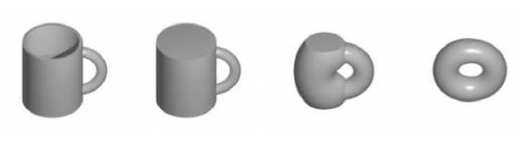
A donut and a coffee cup are topologically the same because the coffee cup can be continuously deformed into a donut.
Source: Lucas Vieira, via Wikimedia commons
Study of Topology
Topology is the mathematical study of shape, with the flexible notion that two shapes can be the same if they can continuously deform into one another via stretching, bending, and twisting but not breaking, tearing, or puncturing. A classic example of this sameness is that a coffee cup can end up deformed into a donut shape without breaking, meaning a coffee cup and donut are topologically the same. In recent years, scientists have turned to topology to understand the shape of data.
Purvine’s team is exploring mathematical techniques to translate hypergraph data about cyber networks into the language of topology to look for topological signatures of malicious behavior such as a cyberattack.
“When something unusual happens, there should be some kind of change in the structure,” said Helen Jenne, a postdoctoral researcher at PNNL who is working with Purvine and is the lead author of the paper explaining the research. “The challenge is we don’t know what we’re looking for, and part of the reason we don’t know what we’re looking for is because the attacks are always changing.”
While the researchers found their technique of translating hypergraph representations of cyber networks into topological structures uncovers patterns in the data that represent adversarial activity, they also found the same patterns that represented adversarial activity also could represent benign activity. In addition, not all the adversarial activity ended up captured by this method, suggesting there is more room for exploration.
Continuing Research
Jenne said this approach is a call to action to focus resources on finding hypergraph constructions and topological methods that could be useful in the ongoing effort to thwart cyberattacks. Indeed, the paper represents just one of several methods the research group is exploring.
“There’s so much to study here, and it seems like there’s something useful,” she said.
Click here to view the entire paper.