
To that end, 94 percent of Wi-Fi networks lack sufficient protections against deauthentication attacks, which are frequently leveraged as part of larger incidents. These vulnerabilities expose organizations to risks such as credential theft, traffic interception, man-in-the- middle attacks and spoofing, any of which could compromise the integrity of critical control systems.
In the second half of last year, critical infrastructure organizations in the United States saw the highest number of attacks, with manufacturing at highest risk.
Nozomi Networks Labs in an analysis of more than 500,000 wireless networks worldwide found only six percent end up adequately protected against wireless deauthentication attacks. This means most wireless networks, including those in mission-critical environments, remain highly exposed.

In healthcare, for example, vulnerabilities in wireless networks could lead to unauthorized access to patient data, or interference with critical systems. Similarly, in industrial environments, these attacks could disrupt automated processes, halt production lines, or create safety hazards for workers.
Impact Phase
Meanwhile, in the second half of last year, 48.4 percent of the observed cyber threat alerts occurred in the impact phase of the cyber kill chain, the report found. This was true across various industries, particularly in manufacturing, transportation, energy, utilities, and water/wastewater. Command and Control (C&C) techniques followed closely (25 percent of all observed alerts). The Labs’ findings demonstrate the presence of adversaries deep within critical infrastructure systems and their intent to persist and maintain control over access.
Researchers also discovered, among 619 newly published vulnerabilities in the 2nd half of 2024, 71 percent ended up labeled critical.
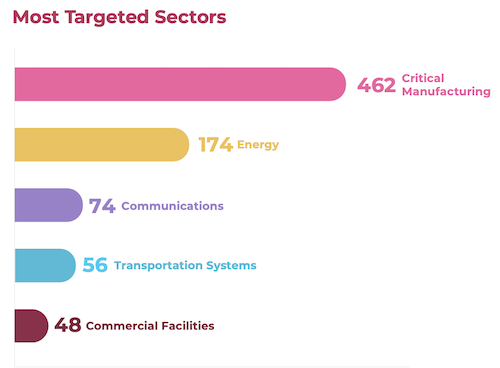
Critical manufacturing leads the way as the most targeted sector.
Source: Nozomi Networks
Additionally, 20 vulnerabilities have high Exploit Prediction Scoring System (EPSS) scores, indicating a high likelihood of future exploitation. Furthermore, four vulnerabilities are already undergoing active exploitation. These findings point to an urgent need for organizations to promptly address and mitigate the most critical and dangerous vulnerabilities.
Additionally, of all ICS security advisories released by CISA over the past six months, critical manufacturing topped the list, accounting for 75 percent of all Common Vulnerabilities and Exposures (CVEs) reported in the past six months. Manufacturing led the pack, followed by energy, communications, transportation and commercial facilities.
“Cyberattacks on the world’s critical infrastructure are on the rise,” said Chris Grove, director of cybersecurity strategy at Nozomi Networks. “The systems we design and defend must not only withstand a barrage of threats in today’s multipolar world but also balance the need to operate safely at scale, where human lives are at stake. By understanding these evolving threats and leveraging actionable insights, we can defend our critical infrastructure system to ensure resilience, safety and operational continuity in an increasingly uncertain world.”
Click here for more on the report.