
These capsules hold sample materials during irradiation experiments, allowing researchers to test how those materials might respond in a nuclear reactor, said researchers at the Department of Energy’s Oak Ridge National Laboratory (ORNL). The capsule provides a pressure and containment barrier for the experiment, which is a critical safety feature.
Researchers used a laser powder-bed system at its Manufacturing Demonstration Facility (MDF) to 3D print the 316H stainless steel capsules. This type of steel is under evaluation because it offers high-temperature strength, corrosion and radiation resistance, proven nuclear-grade performance and weldability needed for safe, durable use in reactor environments.
The team then assembled and qualified the capsules to insert into ORNL’s High Flux Isotope Reactor (HFIR). The capsules underwent a month-long irradiation in the reactor and researchers removed them fully intact. This demonstration sets the stage for future nuclear component designs produced via additive manufacturing.
“As we demonstrate the reliability of these printed components, we’re looking at a future where additive manufacturing might become standard practice in producing other critical reactor parts,” said Ryan Dehoff, director of the MDF at ORNL.

HFIR provides one of the world’s highest neutron flux environments. Moreover, it allows researchers to test and qualify fuels and materials under conditions such as a nuclear reactor.
Fabricating and qualifying experimental capsules to irradiate fuel and material samples is a costly and time-consuming process. It demands custom materials and designs.
Streamlining Capsules
Additive manufacturing, or 3D printing, could streamline the development of experimental capsules.
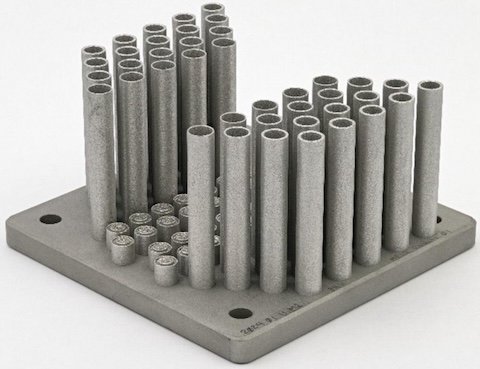
ORNL researchers used a laser powder-bed system at its Manufacturing Demonstration Facility to 3D print 316H stainless steel capsules for use in irradiation experiments. The capsule provides a pressure and containment barrier for the experiment, which is a critical safety feature.
Source: ORNL
In doing that, it could be possible to significantly reduce the cost and time associated with producing these components. That could ultimately drive greater innovation in nuclear science and technology, the researchers said.
“The nuclear materials and fuels research communities are being asked to qualify advanced reactor technologies to survive very harsh conditions. Additive manufacturing will expand my group’s toolset to develop innovative experiments to support this critical need,” said Richard Howard, a group leader in the Nuclear Energy and Fuel Cycle Division at ORNL.