
That waste is a fear and a threat for those storing it, but that could now be part of a solution to giving a boost to the Southwest’s power grid.
The waste is “particularly nasty stuff that sits in containers above ground. And if you come into contact with it, you could die,” said David Hatchett, vice president of research and professor of radiochemistry at UNLV. “That’s where we come in as a university: We can work with that material. And we were asked if we could make it safe.”
Seeing this, the U.S. Department of Energy approached Hatchett and UNLV about the possibility of applying its patented techniques to make UF6 safe. Not only did his team accomplish that feat, it went a step further.

Future Use
“We don’t just make it safe, we actually recover the material for future use,” said Hatchett. “Rather than mining our way into more materials and damaging the environment, we can reuse what we already have sitting there in high abundance.”
There is plenty of nuclear waste to go around.
Hatchett said there are 1.2 million metric tons globally, with 700,000 metric tons in the U.S. alone (that’s about 1.5 billion pounds). Converting this waste into useful material at an industrial scale stands to revolutionize the future sustainability of the region.
“In a place like Las Vegas, for example, we can have solar energy while the sun’s on,” he said. “But what do we do at night? If water is an issue for hydroelectric power at the Hoover Dam, how are we going to produce all of the energy we need? Nuclear can provide stable, high-density power for things like data centers, AI, and other industries needing reliable energy.”
Even after the nuclear disaster in Fukushima, Japan, interest in nuclear power is undergoing a bit of a turnaround.
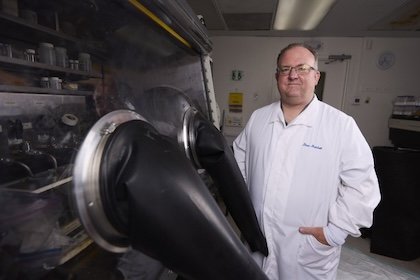
David Hatchett in his nuclear lab is working on how to take nuclear waste and make it a viable, and safe, fuel.
Source: Becca Schwartz/UNLV
The industry is seeing some forward momentum with the successful deployment of Vogtle Units 3 & 4 in Georgia, and more utility operators are investigating involvement.
The natural tendency may be to think of the traditional large-scale towers with steam coming out of the top. But the future is much smaller. The Department of Energy is now offering $900 million in assistance to support the construction of small modular reactors in the country. This is an effort to reduce U.S. dependence on overseas markets for critical materials.
Small Modular Reactors
“They can power a city very easily,” Hatchett said. “Small modular reactors are basically what power our Navy. They’re much smaller than old-school reactors, not apt to go critical, and provide a more reliable source of energy than what we’re accustomed to.”
Private contractor Urenco, a key player in managing the nation’s nuclear waste, provides UNLV with access to UF6 for research. The collaboration is mutually beneficial, providing UNLV with access to the contents and paths to material safety and recovery.
UNLV is one of the few universities licensed to work with radioactive materials, and the only with access to UF6. Its radiochemistry program ranks among the nation’s best. The program blends advanced research in the nuclear fuel cycle, forensics, and fundamental chemistry with rigorous education, preparing students for vital roles in national labs.
A member of Hatchett’s team, Renee Olney, is a graduate research assistant in the radiochemistry program, directly responsible for making the nuclear waste safe, stable, and usable.
“We make UF6 safer to handle by converting it to a more stable uranium product,” Olney said. “And overall, make it a more reusable and safer product in the end.”
She has been in the program for three years, and has multiple publications in the pipeline. The environmental aspect inspires her, as she’s able to combine the recycling of hazardous waste with chemistry, and plans to conduct this work throughout her career.
Brand New Research Area
“This waste processing has never been looked at before, and it’s awesome to be part of a brand-new area of research,” she said. “Even though uranium is one of the most highly-studied elements in the periodic table, no one has really done what I’m doing yet, and that’s really exciting.”
With this innovation, Hatchett envisions a real difference-maker in the years ahead.
“Whenever we can recover useful materials from waste, that is a positive step forward,” Hatchett said. “It’s in our best interest to ask, ‘How do we utilize what’s in front of us in order to prepare and shape the industries that aren’t here yet?’”