
However, detecting contamination quickly and accurately remains a major challenge in many parts of the world. To that end, a new device developed by researchers at the National University of Singapore (NUS) has the potential to significantly advance water quality monitoring and management.
Learning from the function of the oily protective layer found on human skin, a team of researchers led by Associate Professor Benjamin Tee from the Department of Materials Science and Engineering in the College of Design and Engineering at NUS converted this concept into a versatile material, named ReSURF.
Triboelectric Nanogenerator
Researchers incorporated the material into a device known as a triboelectric nanogenerator (TENG), which uses the energy from the movement of water droplets to create an electric charge. The resulting device (ReSURF sensor) can end up applied as a water quality monitor.“The ReSURF sensor can detect various pollutants, such as oils and fluorinated compounds, which are challenging for many existing sensors,” Tee said. “This capability, together with unique features such as self-powered, self-healing, reusability and recyclability, positions ReSURF as a sustainable solution for real-time, on-site, and sustainable water quality monitoring.”

Existing water quality monitoring technologies such as electrochemical sensors, optical detection systems, and biosensors are effective in certain specific applications, such as detecting heavy metals, phosphorus, and microbial pollution.However, these technologies often face limitations including slow response, high costs, reliance on external reagents or power sources, limited reusability, and the need for bulky laboratory equipment or specialized instrumentation.
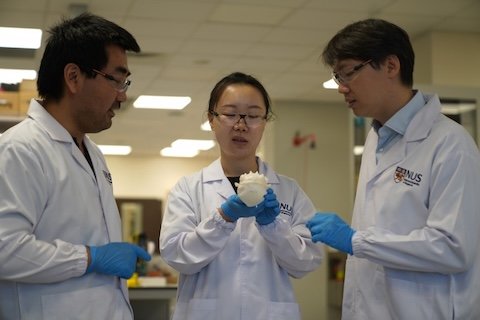
Associate Professor Benjamin Tee (right), Dr. Liu Mengmeng (left), Dr. Yu Kelu (center) and their team from the National University of Singapore developed the ReSURF sensor, an ultrafast, stretchable, self-healing and recyclable sensor for real-time water quality monitoring.
Source: NUS College of Design and Engineering
The ReSURF sensor developed by the NUS team effectively overcomes these challenges, particularly in on-site real-time water quality sensing. The self-powered device has demonstrated the ability to detect water contaminants in 6 milliseconds (i.e. around 40 times faster than a blink of the eye).Additionally, the ReSURF sensor is self-healing and recyclable, making it a sustainable and low-maintenance solution. Being stretchable and transparent, the material can easily integrate into flexible platforms, including soft robotics and wearable electronics, setting it apart from conventional sensing materials.
Environmentally Friendly Solution
Furthermore, the ReSURF material applied as a sensor offers an environmentally friendly solution as it can easily end up recycled due to its solubility in solvents, enabling it for reuse in new devices without suffering a loss in performance.
The ReSURF sensor monitors water quality by analyzing the electrical signals generated when analytes – such as salts, oils, or pollutants – in the water droplets, contact its surface.
When water droplets containing analytes strike the water-repellent surface of the sensor, they spread out and slide off quickly, generating electric charges within milliseconds. The magnitude and characteristics of the signal generated would vary according to the composition and concentration of the analytes present. By monitoring these signals in real time, the ReSURF sensor can rapidly and accurately assess water quality without the need for external power sources.
To demonstrate its capabilities, the researchers tested the ReSURF sensor on a pufferfish-like soft robot in detecting oil in water and perfluorooctanoic acid, a common contaminant found in water sources. The test produced promising results with contaminants producing different voltage signals, providing a proof-of-concept the ReSURF sensor can see use in early surveillance of possible contamination.
The ReSURF sensor offers broad application potential.
Applications
It can end up deployed in rivers, lakes, and reservoirs to enable early surveillance of pollutants, allowing for quick response to water contamination emergencies. In agriculture, it is capable of monitoring water safety in areas like rice fields. In industrial settings and sewage treatment plants, the ReSURF sensor could provide valuable insights for wastewater management.
The research team hopes to optimize the ReSURF sensor by enhancing the specificity of pollutant detection, integrating wireless data transmission capabilities, and scaling the system for long-term or large-scale environmental monitoring.
Additionally, the researchers plan to explore more eco-friendly material alternatives to enhance sustainability and align with evolving environmental regulations.
“Future iterations could integrate additional sensing modalities or machine learning–based signal analysis to enable more precise identification and classification of pollutants,” Tee said. “We envision this platform as a foundation for the development of more intelligent and responsive water quality monitoring systems.”