
With the expected growth in air traffic complexity, future CATS is evolving into a complex cyber-physical-social system, bringing new risks from scenarios like urban air mobility (UAM), new technologies, and new requirements.
The evolution of aviation safety, which has gone through four generations, according to a paper written by Daqing Li, Anzhuo Yao, and others. Each generation has different driving factors and safety improvements, but also faces new risks with the introduction of new technologies. For example, introducing new technologies often results in a temporary decline in safety performance.
Meanwhile, the dynamic nature of CATS also makes risk spreading likely, resulting in conflicts in safety management.

SoS Concept
To deal with these challenges, there is the concept of SoS safety, inspired by the human immune system.
SoS includes three core elements: Safety capability, safety logic, and safety architecture.
Safety capabilities cover aspects such as risk perception, mitigation, and elimination, with elements like global awareness, collaborative orientation, intelligent decision-making, and agile response.
The safety logic features a three line of defense design, aiming to control known risks, be aware of unknown risks, and explore underlying unknown risks.
Safety architecture is a hypernetwork structure, consisting of a safety fundamental network, a safety collaboration network, and a safety decision network. Furthermore, key technologies supporting SoS safety, such as model-based systems engineering (MBSE), digital engineering, and parallel management, are also a part of the discussion.
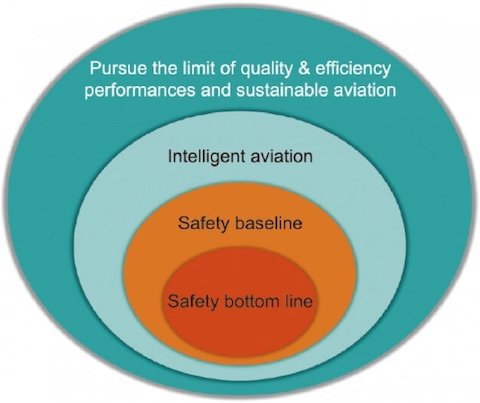
Relationship of CATS objectives.
Source: Daqing Li
The development of SoS safety in CATS could progress in three phases.
In the first phase, resilience management at the operational level is the core, aiming to enhance safety management. Additionally, the second phase extends safety capabilities to the design end, enabling better adaptability to risks. Moreover, in the third phase, with the advent of UAM and mixed operations, SoS safety aims to mitigate unknown risks through the integration of design and operation and the evolution of risk cognition.
Paradigm Shift
The proposed SoS safety concept represents a paradigm shift in complex system safety study. It has implications for safety management, guiding the transformation from isolated system safety to SoS safety, from operational-process-only risk management to the integration of design and operation, and from “process & outcome-oriented” to “capability-oriented” safety management.
Although the concept ended up introduced with civil aviation as an example, it can apply to other large-scale complex systems. Future research should focus on validating the concept through testing and digital engineering, especially in emerging contexts like low-altitude operations and urban air mobility (UAM).
Click here to view “Next Frontiers of Aviation Safety: System-of-Systems Safety.”