
In an effort to learn more and educate the public on this tragic blast, the Chemical Safety Board (CSB) produced an eye opening video showing details behind what went wrong.
The incident occurred when a severely corroded pressure vessel catastrophically failed, causing an explosion that launched the pressure vessel into a neighboring building. One Loy-Lange worker and three others working at another company died in the incident.
Deficiencies in the box making business’ operations, policies, and process safety practices failed to prevent or mitigate chronic corrosion in its Semi-Closed Receiver (SCR) pressure vessel were among the issues that led to the explosion.
Contributing to the incident was Kickham Boiler and Engineering’s performance of an inadequate repair to the SCR in 2012 that left damaged material in place, the City of St. Louis’ missed opportunities to identify and ensure the inspection of the SCR, Arise’s acceptance of and failure to detect Kickham’s inadequate repair, and gaps in Arise’s and the National Board of Boiler and Pressure Vessel Inspectors’ repair inspection requirements, CSB officials said in a final report. (Arise was the authorized inspection agency for Kickham’s repair.)

SCR Failed
The incident occurred when the bottom head of a pressure vessel called a Semi-Closed Receiver, which was used in Loy-Lange’s steam system, catastrophically failed.
The pressure vessel failure caused a boiling liquid expanding vapor explosion (BLEVE) which fatally injured the Loy-Lange employee working nearby and launched the pressure vessel from the Loy-Lange building into the air.
The power of the jet of water rapidly turning to steam broke the vessel loose from its piping attachments and fastenings, propelling it through the internal structure and roof of the building. The downward force of the steam launched the 3,000-pound vessel with a speed of about 120 mph, about 425 feet into the air and about 515 feet from its starting point. The SCR remained airborne for over 10 seconds.
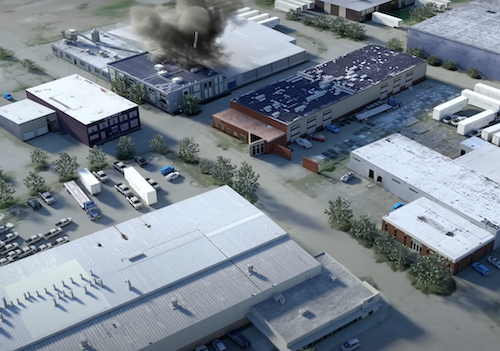
Animated screen capture shows just an airborne pressure vessel after it exploded at the Loy-Lange Box Company and before it landed at the Faultless Linen business over 500 feet away.Source: CSB
The vessel eventually crashed through the roof of the Faultless Linen business over 500 feet away, fatally injuring three brand-new hires filling out paperwork.
“Leaking pressure vessels can be dangerous and should be thoroughly evaluated to ensure they are fit to operate,” said Interim Executive Steve Owens in the video. “But even before a pressure vessel is compromised there are many ways for companies to ensure that damage mechanisms, including corrosion, are properly understood and controlled. Doing so can prevent catastrophic incidents before they ever happen.”
The safety video includes an animation of the sequence of events leading to the incident.
Corroded Pressure Vessel
CSB showed in the video over the course of years, an area of the failed pressure vessel had thinned due to a known corrosion mechanism that was poorly controlled at Loy-Lange. In addition, CSB found Loy-Lange repeatedly ignored clear warnings that corrosion was causing major problems within its operations. In fact, the CSB found that prior to its failure, Loy-Lange ran the pressure vessel normally despite knowing that it was leaking.
“The incident at Loy-Lange resulted from a tragic series of circumstances — ineffective corrosion management, inadequate pressure vessel repair, a lack of inspections, and the absence of sound safety management systems,” Owens said.
Those factors led to a severely corroded pressure vessel, which presented a serious safety hazard.
“To prevent this incident, Loy-Lange had to understand the hazards of its operations and implement and maintain safeguards to prevent corrosion in its steam system and monitor those safeguards to ensure their proper function,” said CSB Lead Investigator Drew Sahli.
Click here to view the video.