
Once released, the liquid nitrogen quickly vaporized, expanded, and accumulated inside a partially enclosed room within a building. FFG used liquid nitrogen for the freezing of cooked poultry products. The following is an update with the ongoing investigation by the Chemical Safety and Hazard Investigation Board (CSB) into the fatal nitrogen release at the Foundation Food Group’s Prepared Food Division facility in Gainesville.
Liquid nitrogen boils (or vaporizes) at -320 °F (-196 °C) or higher at atmospheric pressure. Liquid nitrogen produces large volumes of nitrogen gas when it vaporizes. Nitrogen gas readily mixes with air at room temperature; however, cold nitrogen gas is denser than air and can settle and collect in low areas.
Oxygen-Deficient Atmosphere
High concentrations of nitrogen gas in an enclosed area can create an oxygen-deficient atmosphere. Atmospheres containing less than 19.5 percent oxygen can lead to asphyxia (low oxygen), brain damage, and even death. Symptoms of asphyxia may include rapid breathing, nausea, vomiting, inability to move, convulsive movements, collapse, abnormal pulse, rapid fatigue, faulty judgment, insensitivity to pain, and abnormal emotions. Low oxygen concentrations (less than eight to ten percent) may result in the rapid loss of consciousness without warning.

Contact with liquid nitrogen or cold nitrogen gas can cause severe cold burns, frostbite, and hypothermia. Prolonged breathing of extremely cold gas may damage lung tissues.
The FFG Plant Four building consists of five production lines that made various cooked, partially cooked (par-cooked), and marinated chicken products. Conveyor belts transferred chicken through production equipment, such as ovens, fryers, freezers, and baggers, on each production line. This event occurred on Line 4, which processed fully cooked diced chicken products.
The building had two processing areas: The “raw” area and the “Ready-To-Eat” (RTE) area. The Line 4 process began in the raw area with marination and cooking, then continued to the RTE area, which contained a dicer, freezer, and packaging equipment.
The freezing system on Line 4 was a liquid nitrogen immersion-spiral freezer supplied by Messer LLC. Freezing occurred in two stages:
- In the first stage, a conveyor belt carried the fully cooked diced chicken into an immersion freezer, where it was flash frozen in a -320 °F (-196 °C) liquid nitrogen bath. The chicken and some of the nitrogen vapor produced in the immersion freezer were then moved through a transition box to the spiral freezer.
- In the second stage, liquid nitrogen was added to a spiral freezer, where it vaporized, providing refrigeration. A spiral conveyor belt carried the chicken through the freezer while internal fans distributed the vaporized nitrogen and equalized temperatures within the freezer. Once freezing was complete, the chicken exited the spiral freezer, was packaged, and shipped to customers.
Exhaust systems using ducts and blower fans on the roof moved vaporized nitrogen from inside the freezers to the ambient air through discharge piping above the building.
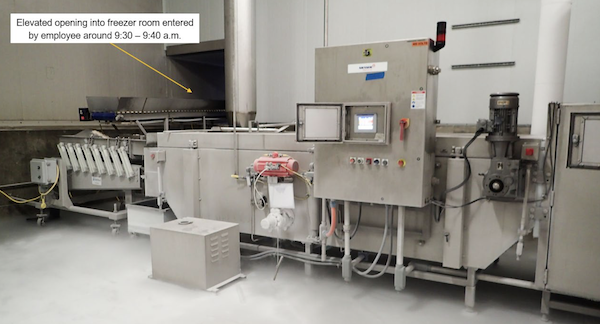
The Line 4 immersion freezer in the freezer room. This photo was taken soon after the incident.
Source: Hall County Fire Services with annotations by CSB
Regulated Control Valves
Control valves regulated the flow of liquid nitrogen from the outdoor storage tanks through piping routed outside the building, along the roof, and then entering the building to connect to each freezer. The freezers were equipped with a computer control system with touch screens to set operating parameters for the freezer system, such as the liquid nitrogen level inside the immersion freezer, conveyor belt speeds, and exhaust fan speeds.
The computer control system programming also included safety interlocks to shut down the freezers automatically. Workers could also initiate these safety interlock actions by pushing any one of the freezers’ 10 emergency stop buttons.
On the day of the incident, FFG employees started processing chicken on Line 4 between 7 and 7:30 a.m. Workers stopped processing chicken at 8:14 a.m. because the freezer was not properly freezing the chicken product. Line 4 production workers went on a break while maintenance staff worked to correct the issue.
When Line 4 workers returned from their 15-minute break, they saw their line had not yet restarted. After the line workers waited for over an hour, one of them entered the freezer room through the elevated opening to check on the maintenance workers around 9:30 or 9:40 a.m. The line worker saw a white cloud approximately four feet high filling the room and one of the maintenance workers lying unconscious on the ground next to the freezer. The line worker exited the freezer room and notified the other workers and supervisors in the RTE area.
At 9:55 a.m., FFG supervisors began evacuating all Plant Four employees from the building and notified management. Approximately 130 workers evacuated. An FFG employee first called 911 at 10:11 a.m., and another employee pulled the building’s fire alarm at 10:13 a.m.
Workers Tried to Help
During the evacuation, some FFG employees in the RTE area stayed behind. Also, a few FFG workers and supervisors in the plant’s raw area went to the Line 4 freezer area to determine what happened and to assist with rescue efforts. Several of these employees, who helped with the rescue efforts, were seriously or fatally injured from exposure to the nitrogen vapors. Autopsy results revealed all six fatally injured victims suffered asphyxiation.
After seeing at least one worker unconscious in the clean room adjacent to the freezer room, a group of three FFG employees ran to the liquid nitrogen tanks at the front of the building and closed valves to shut off the liquid nitrogen supply into Plant Four, at 10:18 a.m.
When emergency responders arrived at the scene at approximately 10:21 a.m., FFG workers had already moved some injured employees out of the affected area. Upon entering the freezer room wearing full gear and using supplied air, emergency responders encountered a four-foot-tall white cloud obscuring their visibility. The emergency responders measured the floor temperatures and found they were colder than – 100 °F (-73 °C). At 10:36 a.m., an emergency responder pushed the freezers’ emergency stop buttons to shut down the equipment.
After the evacuation, some FFG employees showed symptoms of asphyxiation, such as fainting, dizziness, headaches, and nausea. These employees were treated by paramedics onsite. Nine FFG employees were transported to the hospital. Five were treated in the emergency room and released later in the day, three were admitted, and one employee was pronounced dead in the emergency room.
Four out of the five emergency responders from the Gainesville Fire Department and Hall County Fire Services who removed victims while wearing full gear, including supplied-air respirators, were transported to the hospital with symptoms that included dizziness, shortness of breath, and abdominal pain. Three firefighters were treated in the emergency room and released from the hospital later that day, and one was released the next day.
Foundation Food Group (FFG) was formed by a merger of Prime-Pak Foods, Inc. and Victory Processing, Inc on September 18, 2020.
Nitrogen Tank Installation
Messer completed the installation of two liquid nitrogen tanks and a single spiral freezer used on Line 2 in Plant Four on May 8, 2020. Messer finished training FFG employees on the spiral freezer on May 19, 2020. FFG began operating this freezer on Line 2 in May 2020.
After Messer assembled and placed the Line 4 freezer inside the Plant Four building, FFG contracted International Refrigerated Structures to build out a new clean room and add a wall. The build-out and wall installation were completed on December 13, 2020.
The freezer room was not equipped with a mechanical ventilation system. Messer completed the installation of the Line 4 immersion-spiral freezer on December 15, 2020. The Line 4 freezer began operation on December 16, 2020.
Neither the Line 2 nor the Line 4 liquid nitrogen project installations provided atmospheric monitors – room (fixed) or personal (portable) analyzers – to audibly or visually alarm and alert workers of oxygen-deficient conditions.
Since the Line 4 immersion-spiral freezer started up in December 2020, Messer personnel had returned to the site multiple times to troubleshoot conveyor “belt loading” issues, where the diced chicken product was unevenly shifting to one side of the conveyor belt as it traveled through the freezer system. Messer suggested some of these belt loading issues could be due to liquid nitrogen in the immersion freezer tub pushing the product to one side of the conveyor belt.
On January 17, 2021, Messer personnel modified the design of the liquid nitrogen inlet piping into the immersion freezer to slow the velocity of liquid nitrogen entering the immersion tub. FFG personnel also centered and added product guides to the conveyor belt before the immersion freezer to help with belt loading. At the time of the incident, Messer and FFG had resolved most, but not all, belt loading issues in the freezer system.
Troubleshooting Control Levels
Messer personnel had also repeatedly returned to the site to troubleshoot liquid nitrogen level control issues in the immersion freezer. FFG and Messer observed the liquid nitrogen level indicated on the control panel would occasionally be lower than the specified setpoint. On January 23, 2021, Messer replaced the liquid nitrogen control valve and transducer on the immersion freezer, as FFG and Messer believed there could have been a problem with the valve.
During the two days before the incident, January 26 and 27, 2021, FFG employees stopped Line 4 production multiple times because the immersion freezer was not properly freezing the product.
On Tuesday, January 26, 2021, a Messer engineer was on site to witness FFG’s attempt to process 1⁄4-inch diced product on Line 4 and to continue to assess belt loading issues with this product. For this assessment, the liquid nitrogen level in the immersion freezer bath was lowered to 0 inches (meaning that the liquid level was up to, but not above, the conveyor belt), and the level control valve was set to limit its maximum opening to 10 percent open. With this setup, the chicken product was conveyed through the immersion freezer to the spiral freezer, but it was not immersed within the immersion freezer’s liquid nitrogen bath. These control system settings were maintained for the rest of the day.
On Wednesday, January 27, 2021 (the day before the incident), Line 4 was processing 1⁄4-inch diced chicken in the morning and changed to a different size diced product later in the day. That morning, a Messer engineer reduced the external liquid nitrogen tank pressure to 40 pounds per square inch gauge (psig) and set the liquid nitrogen level in the immersion bath to 0.5 inches above the belt to assess belt loading issues with the 1⁄4-inch diced product. An FFG maintenance worker reported to FFG management the liquid nitrogen level within the immersion freezer was too low. An FFG manager called a Messer engineer for guidance at 1:47 p.m. The Messer engineer suggested increasing the limit on the maximum opening of the liquid nitrogen level control valve to 80 percent open to allow more liquid nitrogen to flow into the immersion freezer bath. Line 4 resumed production that afternoon and continued until the end of that day.
Areas CSB is continuing to gather facts and analyze several key areas include:
- Historical and event data
- Inspection and testing of the liquid nitrogen freezer and associated equipment
- Safety management systems
- Regulations, industry standards, and guidance
- Emergency response to a liquid nitrogen release