
The chlorinated isocyanurate compound is referred to by several names, including sodium dichloroisocyanurate (NaDCC) dihydrate and chlorinated dry bleach (CDB-56).
In addition to the fatality and injuries, the explosion resulted in significant damage to the dryer unit. Debris from the explosion struck a methanol pipeline owned by Belle Chemical Company at a co-located facility not owned by Optima Belle, causing a fire.
The following is an incident update from the Chemical Safety Board (CSB).

Chemical Composition
The sodium dichloroisocyanurate dihydrate, NaDCC dihydrate, is a dry white powder containing approximately 56 percent available chlorine (by weight) and approximately 13 percent moisture (by weight). It is a dihydrate containing two water molecules that are part of its crystalline structure.
Hydrates can be removed from NaDCC dihydrate by heating. The first hydrate can start to be removed from NaDCC dihydrate at temperatures greater than 40°C (104°F). After the hydrates are removed, the NaDCC dihydrate becomes sodium dichloroisocyanurate (NaDCC), also a dry white powder.
Optima Belle offers chemical toll manufacturing services and is a tenant at The Chemours Company Belle site in Kanawha County. Clearon Corporation (Clearon) is the manufacturer of CDB-56 and contracted Optima Belle to dehydrate four approximately 8,800-pound trial batches at the Optima Belle facility.
The explosion occurred during the first trial batch.
NaDCC dihydrate is a moisture-sensitive strong oxidizing agent that can cause a decomposition reaction when heated or exposed to small amounts of water. According to Clearon’s safety data sheet, the decomposition temperature is 240°C (464°F) to 250°C (482°F).
Self-accelerating decomposition reactions at temperatures ranging between 45°C (113°F) to 65°C (149°F) have been measured for NaDCC dihydrate.
Blast Temperature
Nitrogen trichloride (NCl3) is a decomposition product of NaDCC, which detonates when the concentration becomes high enough. NCl3 may readily explode when subjected to temperatures of 60°C (140°F) or higher.
A double cone dryer constructed of Hastelloy C276 operating under vacuum (below atmospheric pressure) was used to heat and dehydrate the CDB-56 in the batch operation. Other connected process equipment included a vessel configured with a condenser to collect the water leaving the dryer, a scrubber, and an eductor to create vacuum conditions.
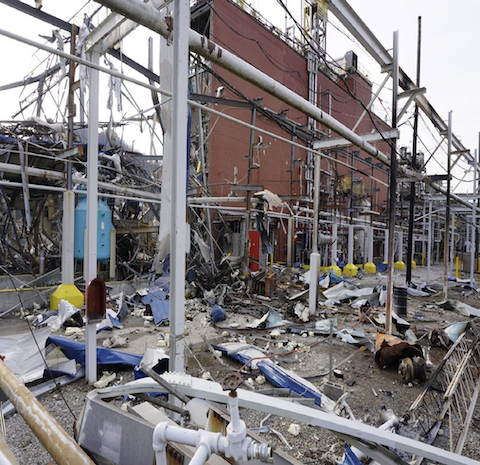
Post-incident photo of the Optima Belle process building and area where the dryer unit was installed.
Source: CSB
Steam was applied to the dryer’s heat transfer jacket for indirect heating of the chlorinated material inside the dryer as it rotated. The available saturated steam from the steam header to the double cone dryer’s jacket was regulated to 30 pounds per square inch gauge (psig) and operated at approximately 134°C (273°F), thus heating the dryer’s internal temperature to a maximum of approximately 130°C (266°F) by design, which was below the prescribed decomposition temperature listed on the CDB-56 safety data sheet and aligned with the dryer heating temperatures included in the Clearon’s Toll Manufacturing Technology Package and Optima Belle’s Procedure for the CDB-56 batch.
The technology package stated, “heat dryer to a temperature range of approximately 100 – 130°C [(212°F – 266°F)], and no more than 140oC [(284oF)]. Note: Somewhat lower temperature may achieve drying [dehydration] if the unit is under vacuum.” The procedure specified an internal dryer temperature of 120°C (248°F) and not to allow the internal temperature to increase beyond 130°C (266°F).
To control the jacket temperature on the dryer, steam or cooling water could be selected manually through hand valves with the feed to the jacket, then regulated automatically through the Distributed Control System (DCS).
Optima Belle production employees added approximately 8,810 pounds (four bags each containing between 2,199 to 2,208 pounds) of CDB-56 to the dryer during the morning of Tuesday, December 8, 2020. At 12:30 p.m., the employees started the dryer’s rotation, reduced the pressure inside the dryer to vacuum conditions, applied a slight nitrogen purge inside the dryer, and slowly added saturated 30 psig steam (approximately 134°C (273°F)) to the jacket.
Dryer Procedure
As prescribed in Optima Belle’s procedure, the dryer was stopped every thirty minutes for a sample to be taken of the powder, which was then visually inspected and examined for water content to monitor the dehydration progress. Later in the day, a decision was made to lengthen the time between samples.
An Optima Belle supervisor told the CSB concerns were raised about the dryer temperature not rising fast enough and the product moisture content not decreasing as expected that afternoon. At 5:04 p.m., steam flow and the dryer rotation were stopped to troubleshoot the dryer’s jacket.
While troubleshooting, the supervisor noticed excessive condensate/water in the dryer’s jacket through a sight glass. He and other Optima Belle employees manually drained the jacket. Once the water was drained from the jacket, the rotation was re-started at approximately 6 p.m., steam was re-introduced to the jacket, and the internal dryer temperature began to rise as expected.
At 7:20 p.m., a sample of the powder – which was analyzed both for moisture content and visual consistency – indicated approximately the same moisture level as previous samples but failed its visual inspection. Dark specks were observed in the white powder.
At 8:13 p.m., after consulting with Clearon remotely, Optima Belle stopped the steam flow, stopped the dryer’s rotation, and raised the dryer pressure to atmospheric pressure to investigate the cause of the dark specks observed in the samples. At this time, the dryer’s internal temperature was slowly increasing. The lab analyzed the last sample at 8:25 p.m., which also failed visual inspection. A vacuum was again pulled on the dryer using the eductor at 8:37 p.m.
Continued to Fail Visual Inspection
ed With the product continuing to fail visual inspection due to the dark specks in the powder, Optima Belle and Clearon planned to take one final sample of the powder from inside the dryer and then allow the dryer to continue rotating for the remainder of the night until the team could regroup in the morning.
At 9:50 p.m., the dryer’s rotation had not been re-started, and the internal temperature rapidly increased to a maximum recorded temperature of approximately 108°C (226°F). The temperature was monitored via the DCS.
The dryer exploded shortly after this temperature measurement.
In its continuing investigation, the CSB is looking at:
- Conditions or sources that could initiate a NaDCC dihydrate decomposition reaction
- Provisions and safety precautions needed to recognize and prevent a self-accelerating decomposition reaction and prevent a similar incident from occurring
- Analyzing the results of the material that was in the dryer unit