
By Gregory Hale
A chilling safety video just launched detailing the fire, explosions, and toxic hydrofluoric acid (HF) release that occurred at the Philadelphia Energy Solutions (PES) refinery in Philadelphia, Pennsylvania, on June 21, 2019.
The incident caused the release of over 5,000 pounds of highly toxic HF, launched a 38,000-pound vessel fragment off-site, and resulted in an estimated property damage loss of $750 million.
The video gives an animation of the sequence of events leading to the incident. The video also mentioned five key safety issues in the incident that were also pointed out in the final report CSB released earlier this month:
- Mechanical integrity
- Verifying safety of equipment after changes to good practice guidance
- Remotely operated emergency isolation valves
- Safeguard reliability in HF alkylation units
- Inherently safer design
At PES, a pipe elbow catastrophically failed due to hydrofluoric acid corrosion, which is a well-known safety hazard. Flammable process fluid escaped through the ruptured pipe elbow. Upon release, the process fluid formed a large ground-hugging vapor cloud about ten feet high that engulfed a portion of the refinery’s HF alkylation unit. The cloud ignited, causing the fire and series of explosions.

Because of the fire, a critical safeguard intended to protect the local community from a release of HF did not function as designed. HF is a highly toxic chemical that is particularly hazardous if a release occurs because it vaporizes, becoming airborne. Breathing HF can cause lung damage and skin contact with HF can cause severe burns and death. If a large amount of hydrofluoric acid had escaped from the refinery, the consequences for the surrounding community could have been disastrous.
“Thankfully, despite the urban location of the PES Refinery, the local community was not seriously harmed,” said CSB’s Interim Executive Authority Steve Owens in the video. “But it could have been worse. This incident should be a wake-up call to industry and regulators to take every step possible to prevent a similar event from occurring.”
In its final report, the CSB made recommendations to the American Petroleum Institute (API) and the U.S. Environmental Protection Agency (EPA).
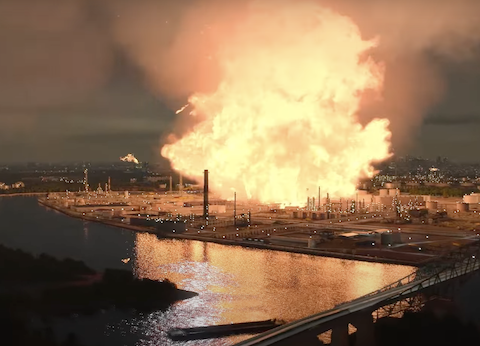
Animation of the aftermath of the final blast in the HF alkylation unit which launched 38,000-pound vessel fragment across a river and others pieces within the boundary of the facility.
Source: CSB
The recommendations aim at strengthening industry standards and regulations regarding several key safety issues found at PES including a lack of remotely operated emergency isolation valves, the need to ensure safeguard reliability in HF alkylation units, and the consideration of inherently safer design.
“To prevent catastrophic incidents, companies and industry trade groups must take swift action to ensure process safety when new knowledge on hazard is published,” said Lead Investigator Lauren Grim in the video. “These actions must include ensuring facilities built before the knowledge is published are still safe to operate. Ensuring safety can include 100 percent inspection of all equipment and piping equipment, replacement equipment and other changes needed to prevent loss of containment events.”
Click here to view the CSB safety video.