
In an effort to reduce these thermal runaway explosions, researchers started up a safety initiative to make lithium-ion batteries safer. These experiments occur in Todd Kingston’s “Energy Storage, Transport, and Conversion Laboratory” on the Iowa State University campus. The explosions are safe and full of data that could help researchers.
Making it all possible is an accelerating rate calorimeter system that’s been running tests in Kingston’s lab for a few months. Kingston, an assistant professor of mechanical engineering, purchased the instrument last year with a $368,000 grant from the U.S. Department of Defense’s Office of Naval Research.
“Abuse testing on lithium-ion batteries is vital for safety and innovation,” according to a description of the instrument by its manufacturer, Thermal Hazard Technology. “It uncovers design weaknesses, reducing the risk of fires and explosions, driving safer battery technology.”
Kingston said the instrument is capable of subjecting batteries to various abuses, including electrical, including overcharging or an external short circuit; mechanical, including crushing; and thermal, including overheating.

Test Chamber
The experiments happen inside the calorimeter’s metal test chamber that’s also enclosed inside a steel blast box.
“This allows us to safely blow up batteries,” Kingston said.
As batteries of various sizes end up tested and, in some experiments, pushed to failure, the accelerating rate calorimeter collects and records data about battery conditions, characteristics and performance.
That includes performing charging and discharging cycles and measurements of voltage, current, temperature, pressure, self-heating rate and material properties. There’s even a window into the test chamber that allows video monitoring.
Kingston has several ongoing battery research projects supported by the Office of Naval Research that will benefit from the new instrument. He’s also thinking about how the instrument can lead to new research and education projects.
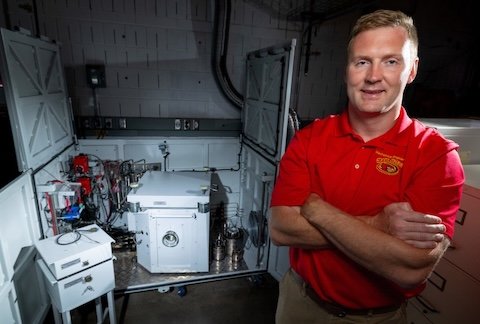
Todd Kingston is using an accelerating rate calorimeter system in his laboratory to test batteries for safety and performance.
Source: Christopher Gannon/Iowa State University
“This is a unique capability,” he said. “This equipment will open a lot of new doors for us.”
The accelerating rate calorimeter will also be a unique and complementary resource for a new battery fabrication and testing center Kingston and other researchers are establishing on campus.
Development of the center gained support with a $400,000 grant from Iowa State’s strategic plan fund supporting innovative projects across campus. The Office of the Vice President for Research, the College of Engineering and the Department of Mechanical Engineering are providing additional support.
Project leaders are Kingston; Cary Pint, the Charles Schafer (Battelle) Chair in Engineering and associate professor of mechanical engineering; and Steve Martin, an Anson Marston Distinguished Professor in Engineering and a University Professor.
Installing New Equipment
Additionally, Kingston said most of the funding has purchased new equipment for the center, including gloveboxes for battery fabrication. Moreover, that equipment is undergoing installation in the laboratory space.
Once the center is operating, researchers from across campus and, potentially, from businesses or other schools could use the equipment to build and study batteries. To that end, user fees will support operation of the center.
“Researchers will be able to take raw materials, fabricate electrodes and then assemble, test and characterize batteries,” Kingston said. Furthermore, that includes thin “pouch cells” now stacked in layers for use in some electric vehicles.
The battery research the new instrument and battery center make possible is vital in a world that’s switching to electric power. Indeed, a 2021 White House report noted, “We can affordably and efficiently electrify most of the economy, from cars to buildings and industrial processes.”
The move to electrify most everything will make another aspect of the battery work at Iowa State even more important, Kingston said.
“We are doing a lot of workforce development,” he said. “Graduate students, for example, are learning battery fabrication, testing and safety. There are unique educational capabilities that come with the accelerating rate calorimeter and the battery center. It’s an education enhancement that allows hands-on testing and learning.”