
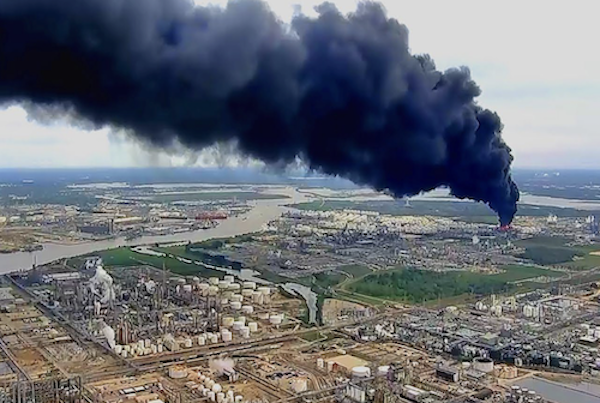
On Sunday, March 17, 2019, a large fire erupted at the ITC bulk liquid storage terminal. The fire originated at Tank 80-8, an 80,000- barrel aboveground atmospheric storage tank that held a blend of naphtha and butane product, a flammable liquid, according to a final report issued by the Chemical Safety and Hazard Investigation Board (CSB).
Once the fire erupted, ITC was unable to isolate or stop the release.
Environmental Impact
The incident also had a significant impacted the environment. A containment wall around the tanks breached and released an estimated 470,000–523,000 barrels of hydrocarbon and petrochemical products, firefighting aqueous film forming foam, and contaminated water into Tucker Bayou and adjacent water, sediments, and habitats. From there, the released materials flowed into Buffalo Bayou and ended up carried out by streamflow and tides into the Houston Ship Channel and surrounding waters. A seven-mile stretch of the Houston Ship Channel adjacent to the ITC Deer Park terminal closed, as were several waterfront parks in Harris County and the City of LaPorte, due to the contamination.

As mentioned the incident did not result in any injuries or fatalities; however, the local community experienced serious disruptions, including several shelter-in-place orders because of benzene-related air quality concerns. In one case, a shelter- in-place ended up issued for the entire City of Deer Park, and local schools and businesses either closed or operated under modified conditions.
A portion of a major highway in the area also closed. ITC estimated property damage resulting from the loss of the First & Second 80’s tank farm associated with the incident exceeded $150 million.
CSB’s investigation identified the safety issues below.
- Pump Mechanical Integrity: ITC did not have a formal mechanical integrity procedure in place that defined requirements for maintaining the mechanical integrity of Tank 80-8 and its associated equipment, including the Tank 80-8 circulation pump. A formal mechanical integrity program for pumps in highly hazardous chemical service could have prevented this incident by providing ITC with additional opportunities to identify pump issues prior to the incident.
- Flammable Gas Detection Systems: Tank 80-8 did not have a flammable gas detection system to warn personnel of a hazardous atmosphere resulting from loss of containment from the tank or its associated equipment. In 2014, a hazard review team recommended the addition of flammable gas detection systems near Tank 80-8; however, ITC did not implement this recommendation, and did not document why it did not implement the recommendations. In the absence of a flammable gas detection system, there were no alarms to alert personnel about the initial release of butane-enriched naphtha product around the Tank 80-8 piping manifold. Consequently, the butane-enriched naphtha product continued to release from the failed pump for approximately 30 minutes, completely undetected, before its flammable vapors eventually ignited.
- Remotely Operated Emergency Isolation Valves: Tank 80-8 and the other aboveground storage tanks located in the First & Second 80’s tank farm were not equipped with remotely operated emergency isolation valves (ROEIVs) designed to mitigate process releases remotely from a safe location. The primary drivers for identifying the need for this type of equipment would have been through implementation of hazard assessments, such as those required by the Occupational Safety and Health Administration (OSHA) Process Safety Management (PSM) standard and the U.S. Environmental Protection Agency (EPA) Risk Management Program (RMP) rule, as well as insurance company audits and/or corporate risk evaluations results. On the day of the incident, the large volume of butane- enriched naphtha product contained in Tank 80-8 could not be remotely or automatically isolated, and it continued to release, via the failed pump, fueling the fire that continued to intensify around the tank. As the Tank 80-8 fire intensified, flames from the fire spread to adjacent tank piping manifolds in the tank farm and eventually compromised the equipment, causing breaches in piping that allowed the hydrocarbon and petrochemical products contained in the storage tanks to release into the common containment area.
- Tank Farm Design: Although the design of the First & Second 80’s tank farm was in accordance with applicable National Fire Protection Association (NFPA) 30 requirements, elements of the tank farm design, including tank spacing, subdivisions, engineering controls for pumps located inside the containment area, and drainage systems, made it difficult for emergency responders to slow or prevent the spread of the initial fire and allowed the fire to spread to other tanks within the tank farm. While NFPA 30 defines minimum requirements for tank farm design, additional industry guidance documents provide more robust tank farm design recommendations. While ITC did not have to implement additional industry guidance recommendations, many of which ended up developed after construction of the First & Second 80’s tank farm, implementation of such recommendations could have prevented the escalation of this incident.
- PSM and RMP Applicability: ITC did not apply a formal process safety management program to Tank 80-8 because neither the OSHA PSM standard nor the EPA RMP rule applied to Tank 80-8 and its associated equipment. Tank 80-8 was not covered by the OSHA PSM standard due to the atmospheric storage tank exemption in the standard, and the EPA RMP rule did not apply due to the flammability rating exemption in the rule for the butane-enriched naphtha mixture. Although ITC applied some process safety management elements across the terminal, the company did not apply other key elements, such as Mechanical Integrity and Process Hazard Analysis, to atmospheric storage tanks in highly hazardous chemical service. Applying these elements would have provided the company with additional opportunities to identify and control hazards through multiple layers of protection, including the examples of preventative and mitigative safeguards discussed in this report. Thus, had ITC developed and implemented a comprehensive process safety management program that effectively identified and controlled hazards for Tank 80-8 and its related equipment, the incident could have been prevented.

What is left of the 15-tank farm at ITC after the three-day fire that started after a failed tank circulation pump led to the leak of a butane-enriched naphtha vapor which ignited.
Source: CSB
Cause of the Incident
CSB determined the cause of the incident was the release of flammable butane-enriched naphtha vapor from the failed Tank 80-8 circulation pump, which accumulated in the area and ignited, resulting in a fire. Contributing to the severity of the incident were the absence of a flammable gas detection system to alert the operators to the flammable mixture before it ignited approximately 30 minutes after the release began, and the absence of remotely operated emergency isolation valves (ROEIVs) to safely secure the flammable liquids in Tank 80-8 and the surrounding tanks in the First & Second 80’s tank farm.
Elements of the tank farm design, including tank spacing, subdivisions, engineering controls for pumps located inside the containment area, and drainage systems also contributed to the severity of the incident by allowing the fire to spread to other tanks within the tank farm. The resulting accumulation of hydrocarbon and petrochemical products, firefighting foam, and contaminated water in the secondary containment area ultimately contributed to a breach of the containment wall and a release of materials to the local waterways.
CSB also determined because of the atmospheric storage tank exemption contained in the OSHA PSM standard and the flammability exemption contained in the EPA RMP rule, ITC was not required to develop and implement a formal PSM program for Tank 80-8 and its associated equipment that could have provided a process to identify and control the specific hazards that resulted in this incident, which also contributed to this incident.
Multiple Recommendations
As a result of its investigation, the CSB made a series of recommendations.
To ITC:
Develop and implement a process safety management system for the ITC Deer Park terminal applicable to all atmospheric storage tanks and associated equipment in highly hazardous chemical service. The program should follow industry guidance provided in publications such as Design, Construction, Operation, Maintenance, and Inspection of Terminal and Tank Facilities and the Center for Chemical Process Safety’s Guidelines for Risk Based Process Safety.
Develop and implement a condition monitoring program for all pumps in highly hazardous chemical service at the ITC Deer Park terminal. Ensure condition monitoring equipment is programmed with control limits, including but not limited to vibration, consistent with ANSI/HI 9.6.9.-2018, that trigger alarms when control limits end up exceeded, and that operating procedures and training reflect the appropriate actions to take when an alarm triggers.
Install flammable gas detection systems with associated alarm functions in product storage and transfer areas at the ITC Deer Park terminal where response plan and operator training for actions to take when an alarm sounds.
Install remotely operated emergency isolation valves configured to “Fail-Closed” for all atmospheric storage tanks that contain highly hazardous chemicals or liquids with a flammability rating of NFPA-3 or higher at the ITC Deer Park terminal.
Conduct an evaluation of the design of all new and existing tank farms at the ITC Deer Park terminal against the applicable sections of the Third Edition of API STD 2610, Design, Construction, Operation, Maintenance, and Inspection of Terminal and Tank Facilities and the 2021 Edition of NFPA 30, Flammable and Combustible Liquids Code.
The evaluation should identify additional engineering controls needed to address minimal tank spacing, subdivisions between tanks, and placement of process equipment in containment areas. In addition, the evaluation should assess the adequacy of the containment wall and drainage system designs, accounting for the impact of firefighting activities, including the application of firewater and foam on these systems. Develop and implement recommendations based on findings from the evaluation.
To American Petroleum Institute (API):
Update API STD 2610, Design, Construction, Operation, Maintenance, and Inspection of Terminal and Tank Facilities, or other appropriate products, to include flammable gas detection systems within the leak detection section or where appropriate. The discussion of flammable gas and/or leak detection should address engineering and administrative controls, including actions associated with responding to a catastrophic or emergency leak.
To OSHA:
Eliminate the atmospheric storage tank exemption from the PSM standard.
To EPA:
Modify 40 C.F.R. § 68.115(b)(2)(i) to expand coverage of the RMP rule to include all flammable liquids, including mixtures, with a flammability rating of NFPA-3 or higher.
Click here to read the full report.