
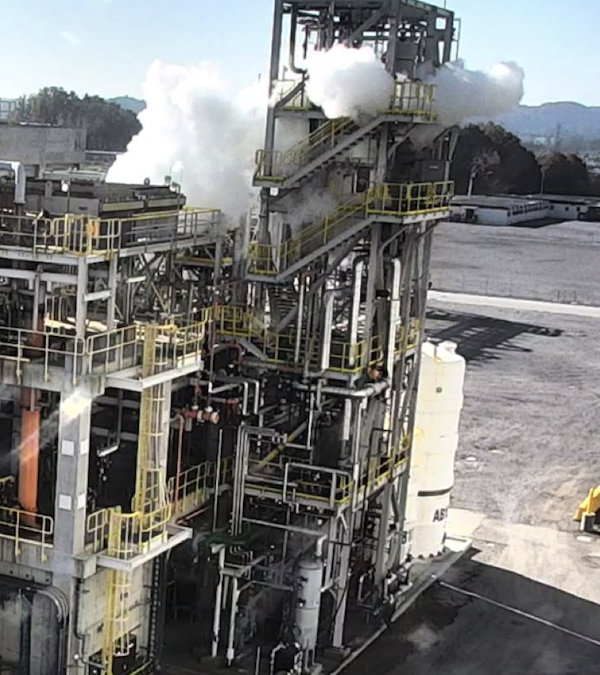
Jesus Jared Aguilar Montes died in the incident after he and two other workers tried to climb down piping on the side of the structure after the HCl release and fell. The two other workers suffered serious injuries in the November 13, 2020 incident.
7 Workers on Platform
At the time of the incident, seven workers from two contract firms were on the fifth-floor platform, which had a single staircase for access and egress. Three of the workers, tasked with bolt torquing, wore full-body chemical-resistant suits. They worked a Jake Marshall. The duty of four other workers, who were from the other contractor, Pen Gulf, was insulating equipment. They wore only standard flame-resistant clothing. The location of the release and the workers’ inability to clearly see their surroundings in the white cloud created by the releasing HCl prevented all the workers from being able to access the staircase to exit the platform.
To escape from the HCl release, three of the contractor workers who were not wearing full-body chemical-resistant suits began climbing down piping on the side of the structure, located 70 feet above the ground. While attempting to climb down, all three workers fell to the ground. One worker died from the fall, and the other two sustained serious injuries. After the release stopped, the four workers still remaining on the fifth-floor platform used the staircase to evacuate the area and reach the ground.

In addition to the fatality and the serious injuries, the Wacker site sustained $214,000 in property damage.

Image of HCl release at the time of release (left) and 15 seconds after release (right).
Source: Wacker
On November 2, 2020, Wacker initiated a scheduled two-week turnaround of the HCl regeneration unit to perform routine maintenance, equipment upgrades, and equipment repairs. During this turnaround, Wacker replaced segments of the AW234 heat exchanger.
Restart Begins
During the night shift on November 12, 2020, Wacker operators restarted the HCl regeneration unit, introduced acid into the system, and brought the unit to operating temperatures and pressures. At 7 a.m. on November 13, the unit reached normal operating conditions.
At 8 a.m., Wacker issued Jake Marshall a work permit to perform a “hot torque” of heat exchanger AW234, whereby Jake Marshall was to check the torque on all the bolts on the heat exchanger vapor outlet piping.
The Wacker permit authorizer and the Jake Marshall foreman then toured the work area and reviewed the permit and equipment they were going to torque. The Wacker permit authorizer also provided the Jake Marshall foreman with an information packet containing the piping installation and operation manual, which included manufacturer-recommended torque values for PTFE-to-PTFE piping connections, but not for graphite connections such as that of the graphite heat exchanger nozzle.
The manual included torque specifications for four-inch piping, which was the size of the piping installed on the AW234 nozzle and discharge line. The packet included torque specifications for PTFE-coated bolts as 24–40 ft-lbs, and non-PTFE-coated bolts as 40–67 ft- lbs. The information provided in the packet pertained only to PTFE-to-PTFE connections.
The packet provided to Jake Marshall did not contain information indicating the 15 ft-lb torque recommendation for bolts connected to the graphite heat exchanger nozzle. Prior to the incident, Wacker provided Jake Marshall with the heat exchanger design drawing, which specified the 15 ft-lb torque requirement. The design drawing was in a nearby meeting trailer. However, on the date of the incident, Jake Marshall workers performing the torquing task did not have the design drawing.
Beginning Torque Operations
At 8:10 a.m., the Wacker permit authorizer left the area and the Jake Marshall foreman led one journeyman and two apprentices to the AW234 heat exchanger to review the tasks and indicate the specific piping connections they were to torque. Once verbal instructions were provided, the workers returned to ground level to prepare for the work, and the foreman left the area.
Around 9:15 a.m., Pen Gulf workers arrived on the fifth floor and began preparing for insulation activities. Unaware of the planned permitted torquing work, Pen Gulf employees were wearing the minimum personal protective equipment (PPE) required by Wacker: Flame-resistant clothing, steel-toe safety boots, and hard hats, with escape respirators and safety harnesses in their possession, as well as safety glasses and gloves.
Before 10 a.m., the Jake Marshall journeyman and apprentice pipefitters returned to the fifth floor of the structure wearing full-body chemical-resistant suits, rubber boots and gloves, and full-face respirators with acid-gas cartridges as required by an internal Jake Marshall policy covering work involving piping containing hazardous chemicals. Before they began the work, the Jake Marshall journeyman instructed an apprentice on which bolts to torque on the AW234 vapor outlet line, which included both PTFE-to-PTFE flanged connections requiring a 40 ft-lb torque, and PTFE-to-graphite flanged connections, which according to the manufacturer, required a 15 ft-lb torque, although the journeyman and apprentice were not in possession of any documentation indicating the 15 ft-lb torque requirement. The journeyman instructed the apprentice to contact the Jake Marshall foreman for further instructions once initial torquing was complete. The journeyman provided the apprentice with a torque wrench set to 40 ft-lbs and moved to overview work in another location in the area.
When the Pen Gulf workers encountered the Jake Marshall workers preparing to begin the torquing task wearing chemical protective clothing and respirators, they questioned the Jake Marshall workers if it was OK for them to be in the area. A Jake Marshall employee told the Pen Gulf workers they could remain in the area since the Jake Marshall workers were not working with chemicals. At this time there were three Jake Marshall and four Pen Gulf employees on the platform, located in the approximate areas.
Just after 10 a.m., the Jake Marshall apprentice pipefitter used the torque wrench set at 40 ft-lbs to check the torque on the blue-colored bolts, which have a manufacturer-recommended torque value of 15 ft-lbs. At 10:04 a.m., the excess torque applied to the blue-colored bolts caused the graphite heat exchanger AW234 to crack, releasing gaseous HCl.
HCl Gas Release
A white gaseous HCl cloud filled the area within 15 seconds, preventing the workers on the platform from being able to see their surroundings. When the Jake Marshall apprentice pipefitter attempted to move away from the release, his chemical suit was snagged and tore open, allowing HCl to enter the suit and cause chemical burns to his skin. While engulfed in the white HCl cloud, he also bumped into equipment on the platform, which knocked off his respirator. Due to the breach of his PPE and location of the release, the apprentice pipefitter was unable to escape to the single staircase to exit the platform. He moved to the opposite side of the platform where the other Jake Marshall and Pen Gulf employees had been working. Jake Marshall workers placed the injured worker in the adjacent safety shower to protect him from the release.
Three of the four Pen Gulf employees put on their escape respirators. Realizing they would have to walk through the chemical release to access the sole platform staircase to escape the area, these three Pen Gulf workers began climbing down piping on the side of the structure, approximately 70 feet above the ground. While climbing down, all three workers fell to the ground. One worker died from the fall, and two sustained serious injuries.
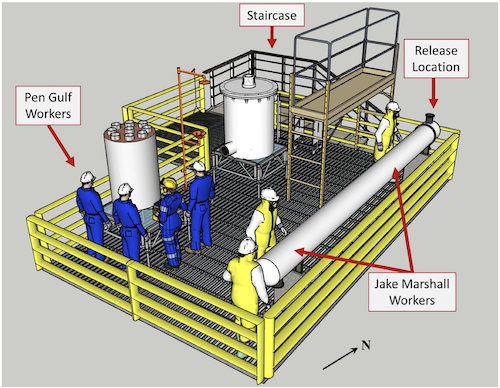
Pen Gulf and Jake Marshall work locations. Figure is not to scale and is intended to provide a general spatial representation of workers and equipment.
Source: CSB via SketchUp
The remaining Pen Gulf worker received assistance putting on her escape respirator from a Jake Marshall worker, who, wearing chemical-resistant PPE, also attempted to shield her from the release. The release continued for approximately three minutes, until all gaseous HCl had escaped from the system. After the release stopped at 10:07 a.m., the three Jake Marshall workers and one Pen Gulf worker used the staircase to evacuate the area and reach the ground.
The CSB investigation identified key safety issues:
Written Procedures. Wacker tasked contractor pipefitters with torquing flange bolts on a live piping segment equipped with multiple bolts with differing torque requirements. Wacker did not have a written procedure to execute the torquing task and instead relied on the piping manufacturer’s equipment manual to communicate the torque requirements to the contractors. The manual, however, did not include the torque requirements for the over-torqued bolts. The resulting lack of clarity of the differing torque requirements led to the inadvertent over-torquing of the flange bolts on live operating equipment, the equipment fracture, and the release of HCl.
Control of Hazardous Energy. Wacker did not treat torquing operations on equipment containing hazardous chemicals as a line break or as an activity that required isolation of hazardous energy since it did not involve the intentional opening of a line. As such, Wacker did not perform a risk analysis to determine whether the torque task could safely end up performed on operating equipment, nor did it implement precautions to mitigate the risk of torquing bolts on operating equipment prior to issuing a safe work permit to the pipefitters, which could have restricted the insulators from being present in the area and prevented their harm.
Simultaneous Operations (SIMOPs). When the incident occurred, four workers from a separate contractor company were performing an unrelated pipe insulation task on the structure, as permitted by Wacker, and were present on the fifth-floor platform near the pipefitter work crew. Wacker did not have a policy or procedure for evaluating SIMOPs, a situation in which two or more operations occur together at a time and place. In addition, there is a general lack of industry and regulatory guidance on SIMOPs considerations available to companies such as Wacker. As a result, Wacker did not evaluate the risks associated with the simultaneous work tasks, and the contract workers not involved in the torquing task were unnecessarily exposed to the HCl release.
Means of Egress. During the incident, seven workers were present on the fifth-floor platform equipped with only a single point of egress. Wacker designed the equipment access structure with a single point of egress based on building code requirements for an “unoccupiable equipment platform.” The CSB found the current International Building Code and National Fire Protection Association building requirements do not provide for sufficient means of egress from elevated work platforms used for accessing equipment containing hazardous materials. Additionally, three months before the incident during the Process Hazard Analysis, Wacker employees identified the need for a second point of egress, but Wacker did not take any action to address this recommendation before the incident.
In light of the investigation and in the final report, the CSB made a series of recommendations:
To the Occupational Safety and Health Administration (OSHA)
Promulgate a standard or modify existing standards to require employers to ensure the coordination of simultaneous operations (SIMOPs) involving multiple work groups, including contractors. Ensure the requirements of this standard or standards apply to both general industry and construction activities and are not limited to activities occurring within confined spaces.
Develop a safety product providing guidance on the coordination of simultaneous operations (SIMOPs) involving multiple work groups, including contractors, that is not limited to confined space or construction.
To Wacker Polysilicon
Develop detailed maintenance procedures for torquing activities which:
- Clearly communicate differing equipment torque specifications, such as those for bolts installed at PTFE-to-PTFE and PTFE-to-graphite connections through visual means such as annotated photographs, signage, physical differentiation, and other methods, as appropriate
- Include procedural requirements for all torquing activities conducted on equipment containing hazardous material to perform an engineering and risk analysis and implement safeguards as a result of the risk analysis
- Ensure that terms such as “hot torque” are clearly defined and employees and contractors have training on these terms
- Ensure procedures and training conform to the mechanical integrity requirements of the Process Safety Management (PSM) standard found in 29 CFR 1910.119(j) and the Risk Management Program (RMP) rule found in 40 CFR 68.73
Develop policy requirements to ensure torquing activities performed on equipment containing hazardous energy are performed safely, such as through de-inventorying equipment or restriction of nonessential personnel and ensuring that essential workers wear proper PPE.
Develop and implement a formalized Simultaneous Operations (SIMOPs) program addressing planned and/or permitted co-located work tasks. Ensure relevant staff are trained on execution of the SIMOPs program.
Install additional means of egress for the T230 desorption tower platforms and other multi-floor equipment structures on-site. After completing these installations, ensure workers are aware of exit locations from the structure platforms through training, drills, or other techniques as appropriate.
To Tennessee Occupational Safety and Health Administration (TOSHA)
Promulgate a standard or modify existing standards to require employers to ensure the coordination of simultaneous operations (SIMOPs) involving multiple work groups, including contractors. Ensure the requirements of this standard or standards apply to general industry and construction activities and are not limited to activities occurring within confined spaces.
To Center for Chemical Process Safety (CCPS)
Develop and publish a safety product on Safe Work Practices, including detailed and practical guidelines for evaluating simultaneous operations (SIMOPs).
To International Code Council (ICC)
Amend the International Building Code (IBC) to address conditions that may require multiple means of egress from elevated equipment platforms used for accessing equipment containing materials that pose physical and health hazards, such as the one used at Wacker in this incident. Specify the minimum number of egress points to increase the likelihood of worker escape in the event of a hazardous material release.
To National Fire Protection Association (NFPA)
Revise NFPA 101 Life Safety Code, NFPA 55 Compressed Gases and Cryogenic Fluids Code, or NFPA 400 Hazardous Materials Code to address conditions which may require multiple means of egress from elevated industrial structures containing hazardous materials posing physical and health hazards, regardless of their combustibility, burn rate, or likelihood of explosion. The guidance should address egress situations for workers on unwalled, elevated structures in the presence of materials posing physical and health hazards. Specify the minimum number of egress points to increase the likelihood of worker escape in the event of a hazardous material release.
Click here for more information on the CSB’s final report on the HCl release at Wacker.