
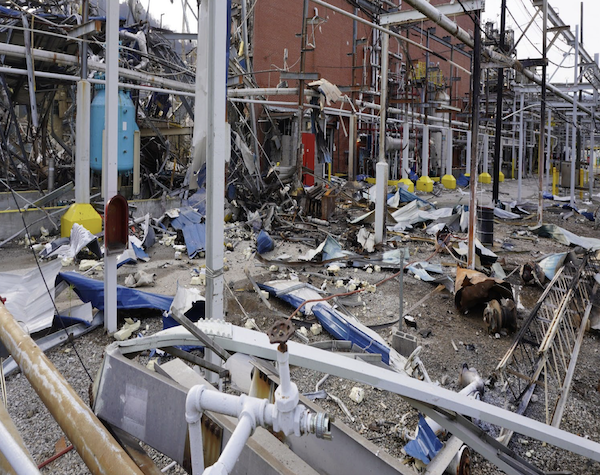
On December 8, 2020, the chemical decomposition reaction and explosion at the Optima Belle facility killed board operator, John Mark Gillenwater II.
Optima Belle rotary dryer’s over-pressurization and its ultimate explosion was a self-accelerating decomposition of heated sodium dichloroisocyanurate dihydrate inside the dryer unit, according to a final report from the Chemical Safety and Hazard Investigation Board (CSB).
Contributing Factors
Contributing to the incident was Clearon Corporation’s failure to transmit sufficient process safety information to Optima Belle, the report said. Also contributing to the incident were Clearon’s and Optima Belle’s ineffective process safety management systems, poor knowledge management, failure to follow existing industry guidance for toll manufacturing, and insufficient regulatory coverage of reactive hazards.

Toll manufacturing is a mode of manufacturing in which a third-party company is outsourced or contracted to provide processing services to a customer. The customer often provides the raw materials and product specifications to the third-party company or details the suppliers that must be used.
At 10 p.m. on December 8, 2020 a pressure-rated rotary double cone dryer containing a chlorinated isocyanurate compound (sodium dichloroisocyanurate dihydrate, or NaDCC dihydrate, trade named CDB-56) exploded, causing a subsequent fire and toxic chlorine release at Optima Belle LLC (Optima Belle) in Belle, West Virginia. The explosion prompted local authorities to issue a shelter-in-place order for the region within two miles of the Optima Belle site for over four hours. The facility experienced significant property damage, and debris was found almost a half mile from the site.
The explosion occurred while Optima Belle, a toll manufacturer, was dehydrating CDB-56 to remove water from the compound to make anhydrous sodium dichloroisocyanurate on behalf of Clearon Corporation (Clearon) through a contractual agreement with tolling outsourcing partner Richman Chemical Inc. (RCI).
While dehydrating CDB-56 inside the dryer unit, the chlorinated isocyanurate compound underwent an unexpected decomposition reaction, releasing gases that increased the dryer internal pressure above its design pressure, and the dryer exploded. Metal debris and dryer fragments propelled off-site and within the facility, striking a methanol pipe that subsequently caught fire. Optima Belle’s estimated property damage from the incident is $33.1 million.
Timeline to the Explosion
Earlier in the day at 10 a.m., Optima Belle employees started the first of four planned batch operations. They added 8,820 lbs. of CDB-56 to the dryer via the manual 10-inch charge ball valve. After adding the CDB-56, Optima Belle closed the valve, started the dryer’s rotation, reduced the dryer’s internal pressure to vacuum conditions, applied a slight nitrogen purge inside the dryer, and slowly added saturated 30 psig steam (approximately 130°C) to the dryer’s jacket. Clearon representatives were present during the start of this first CDB-56 batch operation. RCI, the third party to the tolling agreement, was not present during the December 8 operations.
Throughout the day, Optima Belle and Clearon monitored the dehydration progress. As prescribed in the CDB-56 dehydration procedure, Optima Belle operators stopped the dryer’s rotation and heating approximately every 30 minutes to take a sample of the material, which was then visually inspected and examined for moisture content to monitor the dehydration progress. Later in the day, site personnel decided to extend the time between samples to one hour.
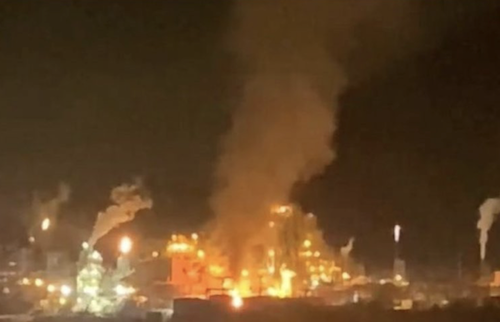
Fire following the Optima Belle dryer explosion.
Source: The New York Times via CSB
By late afternoon, personnel observed the dryer internal temperature was increasing slower than anticipated and the product moisture content was not decreasing as expected. An Optima Belle supervisor observed excessive condensation and water in the dryer’s jacket through the sight glass and asked to stop the dryer to drain the jacket. At 5:04 p.m., Optima Belle employees stopped the dryer rotation, closed the steam supply, and manually drained the dryer’s jacket. At 5:30 p.m., the Clearon representatives left the site for the evening.
At 6 p.m., Optima Belle then restarted the dryer’s rotation and re-introduced steam to its jacket. By 7 p.m., the internal dryer temperature began to rise as anticipated.
At 7:30 p.m., a sample of granular material from the dryer indicated similar moisture levels as previous samples taken throughout the day (greater than 11 percent moisture) but failed its visual inspection. Dark specks were in the white material.
At 8:13 p.m., after a text message between Optima Belle and Clearon regarding the dark specks, Optima Belle stopped the steam flow to the dryer jacket, stopped the dryer’s rotation, and raised the dryer pressure to atmospheric pressure to investigate the cause of the dark specks observed in the samples. While the dryer itself was corrosion-resistant, the valves were stainless steel and, therefore, susceptible to corrosion.
Issues in Process
Optima Belle and Clearon suspected corrosion of the stainless steel valves could have caused the dark specks. Optima Belle employees examined the two stainless steel valves and observed they both were coated with a “black tarry-looking substance” and “a brown, tacky substance,” which they thought could be from corrosion of the steel.
An Optima Belle employee told the CSB upon looking inside the dryer, the product appeared lumpy with a “yellowish” tint, but it was unclear whether the yellowish color was a flashlight reflection. Optima Belle employees also described a strong chlorine smell when they opened the dryer. At 8:25 p.m., the lab analyzed its last sample, which also failed visual inspection.
The dryer’s rotation remained off while Optima Belle investigated the cause of the black specks and inspected the two stainless steel valves. Contrary to the “Emergency Shutdown Procedure,” Optima did not apply cold water to the jacket and did not apply a vacuum while the dryer’s rotation was stopped. The dryer’s internal temperature continued slowly increasing despite no steam being supplied to the jacket. By this point, unidentified by Optima Belle, the dryer contents had likely started to decompose at a rate sufficient to cause a runaway reaction. With no rotation and no applied vacuum, any released water vapor would have remained in contact with the material in the dryer.
At 8:37 p.m., Optima Belle closed the dryer’s 12-inch to 10-inch reducing manual ball valve and again pulled a vacuum on the dryer. Optima Belle did not restart the dryer’s rotation. At this time, the recorded dryer’s internal temperature was 77°C.
At 9:16 p.m., Optima Belle called Clearon to discuss the possible corrosion and the plan moving forward. At 9:20 p.m., while the dryer temperature continued to rise without the application of steam to the jacket, the main scrubber’s pH dropped below 8. Unknown by Optima Belle, this drop in pH was likely the result of decomposition products, including chlorine, exiting the dryer. Concerned primarily with avoiding an environmental permit deviation rather than interpreting this pH drop as an indicator of decomposition activity inside the vessel, Optima Belle took action to increase the scrubber pH. Due to a non-functioning automated caustic supply valve, two Optima Belle employees began manually adding caustic soda to the scrubber to prevent the pH from dropping below 7.
Regroup in Morning
By 9:30 p.m., Optima Belle and Clearon agreed during a telephone call to stop the batch operation for the night and continue troubleshooting the black specks in the morning. Optima Belle planned to take one final sample from the dryer, replace the reducing stainless steel valve with a 12-inch blind flange, apply cooling water to the jacket, and rotate the dryer for the remainder of the night until the team could regroup in the morning. Around the same time, Optima Belle began performing a nitrogen blowdown of the dryer jacket.
Following the call, the board operator left the control room to manually open valves to stop the nitrogen blowdown to the jacket and apply cooling water, as the two field operators were occupied with trying to raise the scrubber pH. At this time, the dryer’s recorded internal temperature was slightly above 80°C.
At 9:40 p.m., before Optima Belle could resume rotating the dryer, the dryer temperature and pressure sharply increased as the NaDCC dihydrate (CDB-56) decomposed. The last recordings in the historian data indicate the dryer temperature reached 108°C and the dryer pressure reached 33 inches of Hg (in. Hg) before the dryer catastrophically exploded.
Debris and metal projectiles from the exploded dryer struck a nearby methanol pipe owned by another site tenant, and the releasing methanol caught fire. Metal fragments were also found off-site on U.S. Route 60, roughly a half mile from the site.
The Optima Belle board operator, who was working to apply cooling water to the dryer’s jacket, was killed in the incident. He was found alive, trapped under debris but died later at the hospital. His death was ruled as an NaDCC intoxication from the fumes he had inhaled. The two Optima Belle field operators ended up evaluated for respiratory irritation, and one Kanawha County resident reported an injury.
The CSB’s investigation identified the safety issues:
- Process Knowledge Management. Effective risk management hinges upon thorough understanding and documentation of the hazards of a process and the chemicals being processed. Clearon lacked effective process knowledge management systems, and as a result the Technology Package that Clearon delivered to Optima Belle as part of the tolling arrangement did not adequately communicate the circumstances and temperatures that could lead to the hazardous decomposition of CDB-56.
- Thermal Hazard Assessment. None of the parties involved in the tolling operation effectively assessed the hazards of the NaDCC dihydrate or operation. The deficiencies included:
— Failure to identify the initiation of a NaDCC dihydrate decomposition as a credible scenario, except as a result of a decomposition temperature greater than 240°C, water intrusion, or contamination of the product with other contaminants. During the incident, a runaway decomposition reaction had begun in the dryer by the time the dryer temperature reached 83°C – a temperature significantly lower than the identified decomposition temperature of 240°C – indicating the thermal hazards of the material were not adequately understood or assessed by the parties involved in the tolling operation
— Inadequate literature searches for publicly available or internal Clearon-owned NaDCC dihydrate data
— Failure to utilize available reactive hazard screening methods to assess the potential reactivity or explosivity of heated NaDCC dihydrate inside a metal pressure vessel.
The effective use of publicly available or Clearon-owned data and thermal hazards evaluation methods could have resulted in a more robust and effective assessment of the hazards of the dehydration operation, which could have prevented the incident. - Equipment Selection and Design. Optima Belle used its existing production equipment for the CDB- 56 dehydration, but this equipment was not designed, sized, or re-engineered for CDB-56 dehydration. As a result, the equipment was not designed to quickly cool the dryer contents or to relieve the excess pressure generated during the decomposition reaction. In addition, Clearon and Optima Belle essentially conducted an experiment on a new method to remove water of hydration from the CDB-56 at full production scale (involving over 8,000 pounds) without first experimenting at the laboratory and pilot scales. The end result of this production-scale experiment was a catastrophic explosion. Had scaled studies been conducted, Optima Belle, Clearon, and RCI likely would have gained additional NaDCC dihydrate thermal stability data, reactivity information, and process knowledge before running the first production-scale batch, which might have led to changes in the process and potentially prevented the decomposition reaction and the explosion.
- Tolling of Hazardous Materials. Companies often augment in-house production by outsourcing chemical processes and other operations. These agreements are called tolling contracts. Clearon established a tolling contract with RCI, a tolling broker, who in turn contracted with Optima Belle. The Center for Chemical Process Safety (CCPS) provides industry guidance for safe and effective tolling arrangements. The dryer explosion might have been prevented had Clearon and Optima Belle applied the suggested industry guidance.
- Regulatory Coverage of Reactive Hazards. NaDCC dihydrate and NaDCC are chlorinated isocyanurate compounds that can undergo self-accelerating decomposition when heated. These reactions may lead to explosions, fires, and toxic emissions with severe impacts to people, property, and the environment. Yet, many such reactive chemicals are not regulated under the Occupational Safety and Health Administration’s (OSHA’s) Process Safety Management (PSM) standard or the U.S. Environmental Protection Agency’s Risk Management Program (RMP) rule. Had NaDCC dihydrate been covered under the PSM standard or RMP rule, Optima Belle would have been required to implement risk mitigation and management systems that could have prevented this incident.
Click here for more information on the comprehensive CSB report.