
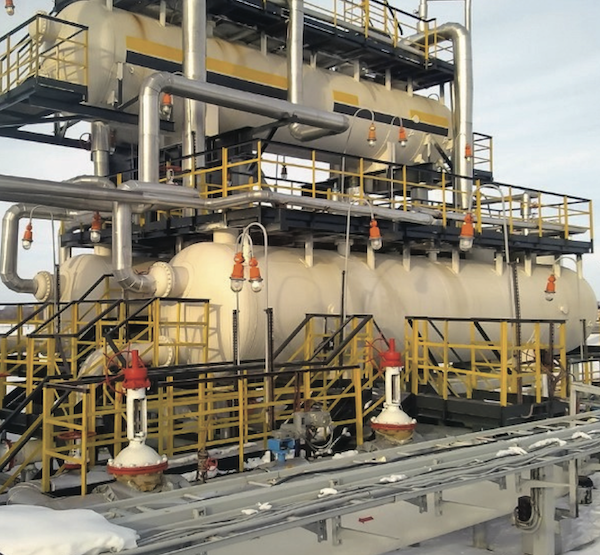
To that end, neglecting to monitor separator pressure levels can result in serious consequences, such as damage to the separators’ structure, environmental contamination, and risks to those nearby. Moreover, high pressure within the separators can cause leaks, ruptures, or even catastrophic explosions.
That is why it is essential to implement strong pressure protection via a Safety Instrumented System (SIS) to eliminate as much risk as possible and keep everything up and running. A SIS consists of one or more Safety Instrumented Functions (SIFs) that take processes to a safe or desirable state. A typical SIF would involve a sensor such as a pressure transmitter, a logic solver that reads the process variable signal from the sensor, and an actuator or final element triggered by the logic solver to take the process to a safe state.
For upstream oil and gas locations that only have a single separator with one pressure signal to monitor, single-loop logic solvers like safety trip alarms provide an emergency shutdown in case of excessive pressure readings.
Multiloop Logic Solver
Larger logic solvers such as Safety Programmable Logic Controllers (PLCs) normally see action when there are multiple points or loops involved in a SIS. They also come with a hefty price tag. Due to the limited number of safety loops at an upstream wellhead where separators see high use, a safety PLC would be overkill.

However, a new type of logic solver, the SLA Multiloop Safety Logic Solver, can handle up to three SIF loops with 17 onboard I/O points. Unlike a simple single-loop logic solver, the SLA has voting and logic capability similar to a traditional safety PLC, but without complex programming.
The SLA implements math with Excel-like formulas and voting logic through checkboxes in a license-free FDT/DTM programming environment as opposed to complex safety PLC programming. This offers a more cost-effective and efficient logic solver solution where more than one separator pressure or loop needs monitoring.
As mentioned above, the STA Safety Trip Alarm is a single-loop logic solver that responds to hazardous process conditions by providing emergency shutdown or early warning indication in an SIS. It has an exida certification and is SIL 2/3 capable. The STA is pushbutton or PC-configured and has a local readout to show separator pressure.
Meanwhile, the SLA is an exida-certified SIL 2/3 capable Multiloop Safety Logic Solver and Alarm that performs as a single or multiloop logic solver incorporating enhanced math, voting, and logic capability to act on potentially hazardous process conditions in a SIS. The SLA can handle up to three safety loops and comes standard with six analog inputs, four discrete I/O points that are programmable as inputs or outputs and has four SPDT relay outputs. Optionally, the SLA can end up fitted with three analog outputs to retransmit any input or internally calculated variable. Features like internal power supplies on the inputs to power connected transmitters and failover capability for redundant input monitoring are standard on the SLA.
Selection Tips
If you know a safety PLC is too much for your safety application and are trying to decide between a single loop STA or a multiloop SLA logic solver, consider the following criteria:
- The STA can handle only one SIF at a time, while the SLA can handle up to three SIFs.
- The SLA has easy-to-use voting logic capability, the STA does not have any voting capability.
- Both the STA and SLA are exida-approved and SIL 2/3 capable.
- The SLA can handle up to 16 alarms while the STA can only handle two alarms.
- The SLA includes an onboard read-only web server that allows all SLA parameters to be read with an off-the-shelf web browser. The STA includes no digital interface or output.
- The SLA accepts six analog inputs, while the STA accepts only one input.
- The SLA has four discrete input/output channels that could suppress the shutdown circuits/alarms during process startup.
- The STA has no discrete input channels.
- The SLA has three analog outputs which can retransmit the separator’s pressure readings to an auxiliary monitoring device, while the STA has only one analog output.
- The SLA analog outputs pass HART data when corresponding analog input channels end up connected to HART devices allowing full access to connected field devices by HART hosts. The STA does not pass any HART data.
- The SLA has an onboard event logger that captures key data that can export to a .csv file, while the STA has no logging capabilities.
- The SLA supports read-only MODBUS/TCP and MODBUS RTU industrial protocols.
- The SLA has an intuitive equation/expression editor for math and logic functions, while the STA has no math or logic capability.
- Both SLA and STA support operating temperature ranges of -40 to 85°C.
By evaluating the specific capabilities of each type of logic solver, tailored safety solutions can end up applied for each type of protection needed.