
In one application, Zone 3’s ideal temperature range is around 250°C, Zone 2’s ideal temperature range is around 200°C, and Zone 1’s ideal temperature range is around 150°C. Closely monitoring these temperatures, providing alarming, and possible shutdown of the process is crucial.
The safety logic solver alarm (SLA) can help mitigate this situation by accepting up to six temperature inputs, in this case type J thermocouples, and performing an absolute differential calculation between two closely mounted temperature elements in each zone. The SLA can implement up to 16 alarms based on any input, equation, or combination of inputs/equations.
This application requires three separate alarms, one for each zone, where each alarm ends up configured to activate if more than a 25°C temperature differential exists between each zone’s lower and upper temperature points.
Meanwhile, the temperature differential for each zone ends up calculated with an absolute differential equation via the SLA’s Internal Variable/Equation Editor feature. Furthermore, an alarm voting strategy will drive three of the SLA relay outputs.

Relay Output 1 will activate an alert if any of the three zones experience an alarm (1oo3 voting). Relay Output 2 will issue a warning if any two of the zones are in alarm (2oo3 voting), and Relay Output 4 will initiate a shutdown of the distillation column if all three zone alarms are active (3oo3 voting) or if there is an SLA device fault.
Capture Maximum Temperature
Moreover, a contact closure wired to the SLA’s Discrete Input 1 can release Relay Outputs 1, 2 and 4, all latching relays, once an alarm voting condition(s) has become inactive. Discrete Input 2 will be utilized to reset a running min/max function that will capture each zone’s maximum temperature, since last reset.
A BPCS (Basic Process Control System) monitors each zone’s average temperature via the SLA’s three analog outputs. All inputs, outputs, alarms, faults, and various other parameters from the SLA end up transmitted via MODBUS/TCP over Ethernet to the BPCS.
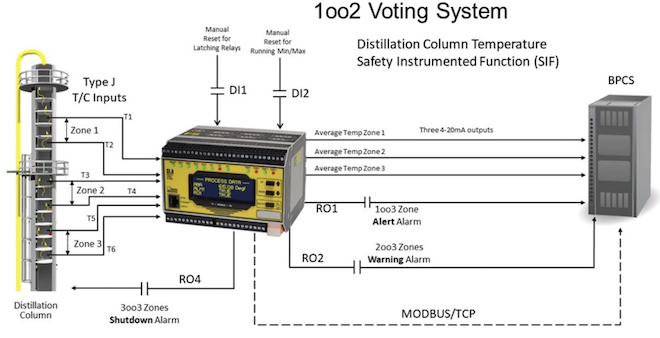
Case study on monitoring temperature stratification in distillation columns.
Source: Moore Industries
Additionally, the SLA’s event logger will end up enabled and configured to monitor and store all diagnostic and alert information for the analog inputs and relay outputs. This event log file can then download from the SLA as a .csv file for viewing, analysis, and archiving.
Key attributes of the SLA:
- SIL 2/3 capable exida approved to IEC 61508:2010 standard
- Easy-to-use equation editor allows for quick absolute value temperature calculations
- Voting architecture alarms of 1oo3, 2oo3 and 3oo3 simple to configure with checkboxes
- -40 to 85 degrees Celsius ambient temperature operating range
- Standard MODBUS/TCP protocol sends all process and diagnostic data to BPCS