
The issue is, however, ceramics can develop cracks often caused by fast temperature changes. The cracks then get battered by the particulate matter and the cracks can become even larger.
Should constant temperature shocks cause ceramic failure, there needs to be an alert ready to go. The ceramic also acts as a temperature insulation between the fluid and the outer metal reactor skin. One way to detect failure of the ceramic is to monitor the reactor skin temperature. A hot spot is a sign of trouble.
It starts with the TCM Temperature Concentrator Module which has 16-channel temperature inputs, with each input being sensor configurable for any RTD or TC utilized. The native output of the TCM is HART, but if you prefer, it can also convert to MODBUS RTU.

Two TCMs can end up converted to MODBUS by using one HMC HART-to-MODBUS converter. If you still have more points to collect, you can duplicate this system as many times as needed and then multidrop the MODBUS communication from each of the HMCs back to your DCS.
Key attributes for the TCM:
- Class 1, Div 2/Zone 2 or Intrinsically Safe with barriers
- Ambient tolerance: -40 to +85°C
- Temperature to MODBUS: Once it’s digital; keep it digital
Click here for more information.
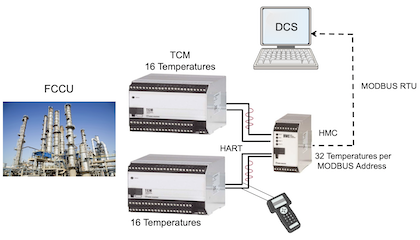
Reactor skin temperature monitoring can alert to detect reactor failure.
Source: Moore Industries