

The incident occurred November 27, 2019, at 12:54 a.m. when a piping section ruptured, releasing highly flammable butadiene that quickly ignited. The resulting pressure wave destroyed parts of the facility and injured two TPC employees and a security contractor.
The blast damaged nearby homes and buildings and was felt up to 30 miles away. Local officials said process fluid that continued to escape from ruptured equipment fueled fires that burned for more than a month.
Failure to Identify
The probable cause of the incident, the CSB said, was TPC PNO’s failure to identify than an out-of-service pump withing the butadiene unit caused a hazardous temporary dead leg, which allowed popcorn polymer to develop and exponentially expand in the piping section until the piping ruptured,. The pipe rupture caused highly flammable butadiene to release into the unit, which ignited and caused and explosion followed by multiple subsequent explosions.

“The incident at TPC was the result of a known safety hazard – popcorn polymer – that was poorly managed and controlled at the facility,” said CSB Chairperson Steve Owens. “The result was a catastrophic incident that caused hundreds of millions of dollars in damage to the facility and nearby homes and business and resulted in a mandatory evacuation being ordered for everyone within a four-mile radius of the facility.”
The CSB’s investigation identified four safety issues which contributed to the incident.
- Dead Leg Identification and Control: The TPC facility had a procedure in place to minimize popcorn polymer hazards associated with dead legs. But that dead leg procedure did not identify all potential temporary dead legs within the unit, including the one that eventually ruptured. Further, the American Chemistry Council’s (ACC’s) Butadiene Product Stewardship Guidance Manual does not contain information on the potential consequences of dead legs or how companies should identify, control, or prevent them.
- Process Hazard Analysis (PHA) Action Item Implementation: A 2016 PHA of the butadiene process at TPC recommended that piping associated with out-of-service equipment be flushed monthly. Yet, his recommendation, which could have helped to flush popcorn polymer out of the dead leg piping that ultimately ruptured, was never implemented.
- Control and Prevention of Popcorn Polymer: The CSB determined that TPC did not have sufficient internal policies to lead employees to shut down and clean the butadiene unit after it experienced exceedingly high levels of hazardous popcorn polymer. The CSB also determined that additional guidance in ACC’s Butadiene Product Stewardship Guidance Manual providing mitigation strategies that companies should follow when popcorn polymer is identified could help prevent future incidents.
- Remotely Operated Emergency Isolation Valves: The CSB found that there were no remotely operated emergency isolation valves installed on equipment that was part of TPC’s butadiene process. Had such valves been installed, the initial release from the ruptured piping could have been minimized and some of the subsequent explosions may have been prevented.
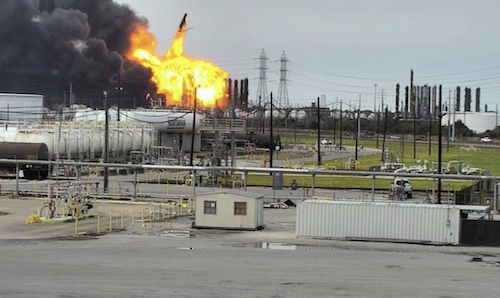
The explosion at the TPC Group Port Neches Operations facility chemical plant in Port Neches, Texas, that propelled one of the unit towers into the air.
Source: Huntsman Corporation
CSB Recommendations
As a result of the incident, the CSB made a recommendation to the TPC Group to develop and implement a process to identify and control, or eliminate, dead legs in high-purity butadiene service.
This process must include requirements for identifying potential dead legs, implementing preventive design strategies, preventing popcorn polymer buildup, and effective management oversight.
CSB also made recommendations to the American Chemistry Council to revise its “Butadiene Product Stewardship Guidance Manual” to include guidance on identifying and controlling or eliminating dead legs in high-purity butadiene service, as well as provide guidance on a methodology to help identify what should be considered excessive or dangerous amounts of popcorn polymer in a unit.
“We believe our final report and recommendations will help facilities that handle and store large quantities of butadiene better control popcorn polymer formation and growth within their processes,” said CSB Board Member Sylvia Johnson said. “Doing so can prevent another terrible incident like the one that occurred at TPC.”
Click here to view the entire report.