
By Gregory Hale
Within the manufacturing sector, the phrase you hear the most is safety is job one; while that is true, there does appear to be a schism between what is said and what is actually occurring, a new report found.
In this age of digitalization and advanced technology that should allow for greater plantwide safety, 66 percent of companies said there are disparities between process safety goals and reality, according to the Sphera 2024 Process Safety Report. What is interesting is those numbers remain virtually unchanged since the first edition of the Process Safety Report nine years ago.
With process plants aging, more workers exiting the industry, and visibility into potential hazardous incidents not very strong, for companies to achieve a greater safety profile they must adopt a more digital capability.

Senior Management Watching
“The stakes are higher than ever for process safety improvements,” said Paul Marushka, Sphera’s chief executive and president. “On the bright side, there is increased interest from senior management who appreciate the connections between improved systems, profitability and competitiveness. The reality is that improving process safety performance helps to keep people, assets and the environment safe while also reducing costs for stakeholders.”
For the report, Sphera, surveyed 300 process safety management (PSM) and operational risk management (ORM) professionals from around the world and in 10 different industries for the report. The survey explored the state of process safety and operational risk management in some of the most high-hazard industries, from petrochemicals to power utilities.
As mentioned, 66 percent of respondents still perceive gaps between their companies’ process safety goals and reality. In large part, the gap remains because too few companies have implemented digital solutions for PSM, according to the report. Adoption of these tools stalled. While they desire to streamline these processes, manufacturers perceive digital solutions as overly complex and challenging to implement. Other reasons may include a lack of qualified staff or the funding for digitalization.
Report Numbers
Despite advances/availability of technology, the report found companies are having a hard time raising the bar for process safety improvements:
- 23 percent of companies complete all safety-critical maintenance activities on time and on schedule
- One in 10 are confident they are aware of all major accident hazards (MAHs)
- As facilities continue to age, 39 percent of respondents remain concerned about visibility
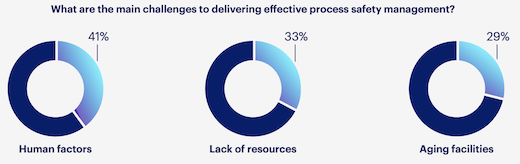
Chart shows challenges respondents feel they face to deliver effective process safety management.
Source: Sphera
Along with technology issues, there are also challenges in the workforce:
- Human factors are the top challenge to delivering effective process safety management (PSM) (41 percent training and competency and 40 percent management involvement)
- Nearly half of respondents (49%) see loss of/lack of experienced personnel as the top factor to cause risk to increase
- Through demographics and other job avenues, experience is exiting hazardous industries; however, attracting new field personnel remains difficult.
In addition, compliance is a driving force in process safety:
- 74 percent of respondents said regulations have helped improve safety, yet just over half of respondents (56 percent) believe organizations have moved beyond compliance as an obligation. PSM is an integral part of Environmental, Social, and Governance (ESG).
- Companies include process safety strategies/incidents in annual sustainability reports. Sustainability is a consideration at the organizational level, as well as in individual roles, for 80 percent of respondents.
Over time, there has been a material shift in process safety ownership as plants get older and the probability and consequences of incidents is becoming more significant, and that means process safety is shining brighter on the radar of leadership.
On top of that, compliance obligations and sustainability regulations could be why 32 percent of respondents now say senior leadership is driving process safety. Additionally, the responses show that risk awareness is growing across all roles.
Safety a Financial Advantage
Speaking of leadership, showing the financial advantage of a strong safety environment can only mean good things. To that end, reducing downtime is becoming a bigger driver for improving safety performance, according to the report. At its core, business continuity is a financial objective.
So, if respondents feel these concerns are driving PSM performance improvement, it’s logical to think senior leadership is playing a bigger role. The reality is you can drive PSM by showing how it helps keep the plant running – and production uptime is an increasing focal point.
Click here for more on the Sphera 2024 Process Safety Report.