
Normally, it takes painstaking laboratory work to determine details behind an event such as a nuclear explosion, including critical requirements like tracking down the source of the materials used.
When a rush of nuclear and chemical reactions occur, there could be hundreds of isotopes and chemical compounds created and some quickly blinking out of existence. Putting all the molecular puzzle pieces together to create a confirmed description of what happened is a long and tedious process.
Knowing that, scientists at the Department of Energy’s Pacific Northwest National Laboratory tapped generative AI and machine learning, as well as cloud computing resources from Microsoft, to show how a much quicker analysis. Researchers showed AI can help solve some of the complicated chemistry questions that scientists confront when analyzing a mix of radioactive debris from a nuclear explosion.
Speed the Process
A persistent goal is to speed up the process to identify key information about a nuclear explosion and deliver answers even more quickly. This research marks an important step toward that goal by further prioritizing and targeting the chemical steps required to do so, ultimately reducing the time required in the laboratory.

“There’s a tremendous amount of radiochemistry that needs to occur to determine the fingerprints of a nuclear explosion,” said Nic Uhnak, the PNNL radiochemist who led the study. “The process has to be done quickly, but scientists face a very complex chemical environment, with high radiation levels and many separate chemical processes occurring simultaneously. You’re dealing with highly complex chemistry and many potential laboratory experiments and analyses.”
Uhnak compares the post-detonation analytical process to identifying the sources and features of the ingredients of a cake already baked. What farm did the eggs come from? How many were used? Was the flour free of gluten? What type of oven ended up used to bake the cake? And so on. If so many questions can be asked of a simple cake, one can imagine the questions to address after a nuclear explosion.
PNNL is part of a group of national labs and law enforcement agencies that steward the U.S. government’s nuclear forensics capability. PNNL and others feed information interpreted by other parts of the system to make important attributions and decisions.
Asking Questions
In this work, the PNNL team put forth a set of chemical forms likely to be in the debris and asked basic questions about the subsequent chemistry. Which reactions would most likely to occur? What laboratory experiments do we need to answer the questions at hand? Which experiments should occur first?
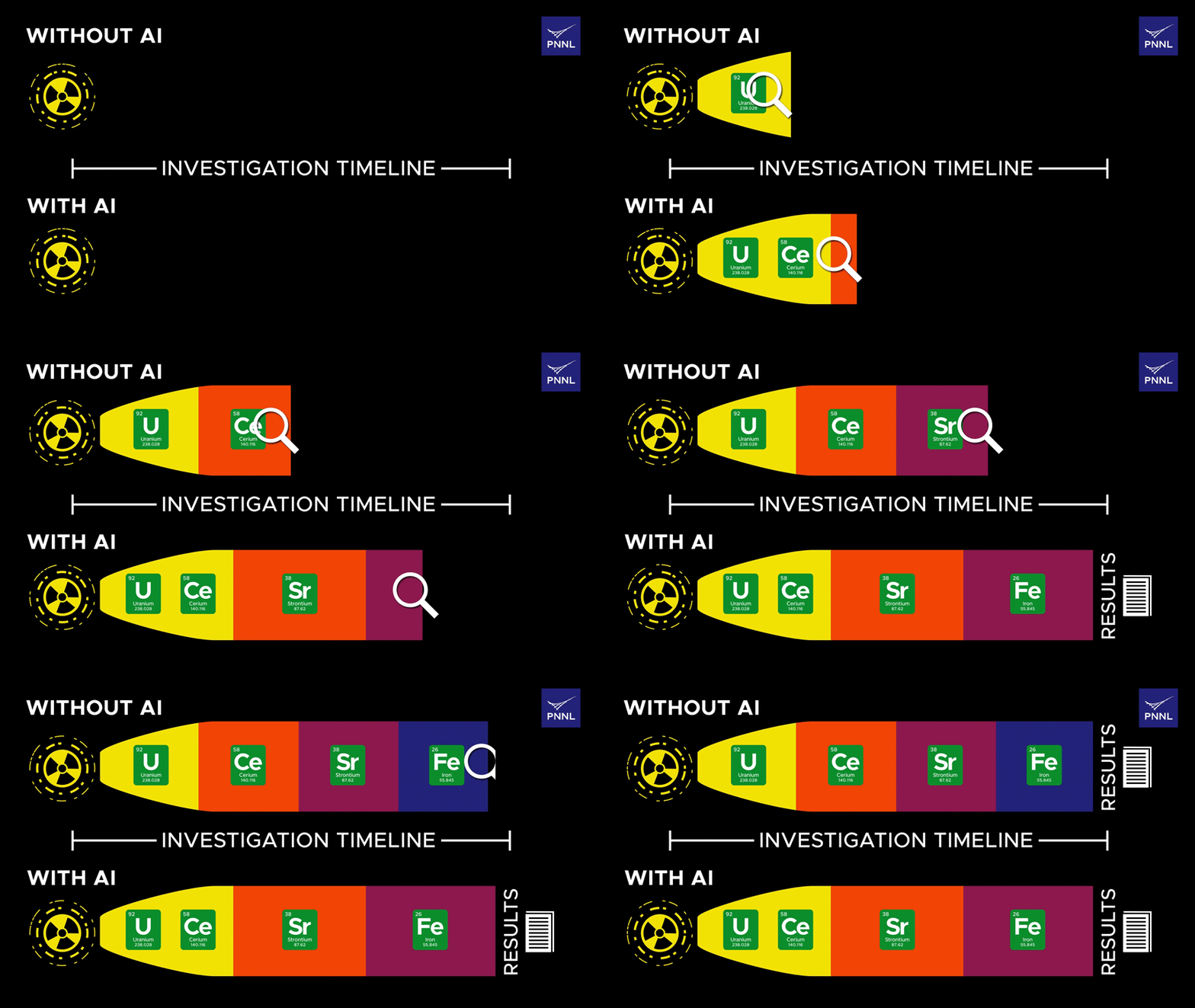
AI could help take a first step to speed up how quickly experts are able to learn details about nuclear events.
Source: PNNL
The remnants of a nuclear explosion would include many elements, including much of the periodic table – and several different chemical forms of many of them. Uranium, strontium, iron and cerium would be present. Analysis often includes putting the materials into an aqueous bath such as nitric acid, then doing a series of tedious chemical separations to learn more about each component.
In the new research, the team used AI-enabled high-performance computing to simulate the complex computational chemistry involved and to determine some chemical properties. These included calculations of stability constants. Those numbers help scientists understand the strengths of bonds between ions or molecules to form molecular complexes, how likely these complexes will stick together or break apart, and how energy flows in such an intricate system. Many such calculations taken together help scientists direct chemical separations that allow them to understand exactly what they’ are looking at, what happened and where materials came from.
More Benefits
The team showed the AI model is able to explore and calculate the properties of a huge number of possible molecular combinations, far more than any scientific team could explore in the laboratory.
“Generative AI calculates in many dimensions at once, in a way that is difficult for a person,” said Hadi Dinpajooh, a computational chemist and an author on the paper. “The model allows us to significantly reduce the timeline to explore all the possibilities.”
PNNL scientists believe this sort of chemical separation modeling driven by AI would benefit other questions involving nuclear science. One case in point is the production of medical isotopes such as molybdenum-99, used to help diagnose cancer and other health conditions. Molybdenum-99 ends up produced through the fission process and requires chemical separations like those the team is exploring.
The mathematics are daunting. To tackle the math, PNNL teamed with Microsoft to deploy Azure Quantum Elements, a cloud computing resource.
That system utilized powerful computer chips from NVIDIA, including 230 NVIDIA H100 GPUs. Altogether, combined with other computing resources, the team used 55 terabytes of RAM to crunch through the questions – an analysis which represented just one step in the long chain of analyses that would occur after a nuclear detonation.
The technical management for the PNNL-Microsoft collaboration endedup handled by computer scientist Paul Rigor, whose expertise bridged the gap between the project’s research demands and the computing infrastructure that Microsoft provided.
“This first paper along these lines is a baby step, but it’s an important step,” said Uhnak. “Anything we can do to speed the process of analysis is a win.”
Click here to read the paper.